Teaching
these methods has become a cottage industry
sucking "talent" away from the mission fields to
the Athens of
the South.
To see the Woodmont Hills, "Look to the Hills"
and the Zoe Group connection Click Here. These groups specialize in
training people to manipulate the "audience" in
church meetings. The goal is to "lead the
worshippers into the presence of God." In
reality, they are pushing body religion which,
in the end, will damage people and the seekers of the next thrill will move on to
the next venue.
Children
believe that they are loving "kitty" when they
are really torturing the poor creature. In the
same way, the feel-good (or bad) preaching and
music begins by creating pain. For instance,
the ear-shattering, pulpit thumping preaching
actually hurts. If this happened in a
production plant the speaker and band would be
hauled into court. Next, the body tries to protect
itself. In self-defense, it produces endorphins and other drugs to deaden the
pain. Because it overdoes the pain, you get an
extra fix of a morphine-like drug. You
then feel good and because fools love to be
fooled you believe that the feeling is the
speaker-singer-induced god moving around in your body.
Remember
the next time: the sequence is hurt, heal and hurrah. Those with a spiritual mind
will just say, "HUSH. The Lord is already in His Holy Temple."
But the
Lord is in his holy temple: let all the
earth keep silence before him. Habakkuk
2:20
When the
beautiful, talented, loud, mechanics of
complex harmony began their ancient pagan
chant you can be sure that you are being chemically and sexually
assaulted to
force you into "knowing god personally" so
that the hair stands up on the back of your
neck and a cold chill sweeps up and down your
body like the hands of a skilled lover. You
are under a drug attack. This is why you run
for your life before the closing prayer can be
finished to dismiss you from the spiritual
temple and out to the profane world. But on
Sunday night you will join the congregation
"disguised as empty pews" to get another fix.
This is
identical to the loud, charismatic,
enthusiastic (meaning en theos o mania) speaker who dances across the stage, hands waving,
feet keeping cadence. The voice projected like
a stone from a sling and the musical, sexual,
assualtive attack is identical to instruments.
Among the literate this produces nothing but a
rustle of song books during "act three."
Without knowing why, the most ancient pagan
priests and priestesses understood that a form
of music which manipulates the body as well as
the brain can cause people to hallucinate and actually believe that they
are in the presence of the gods. They were
tapping into a natural, and often useful, form
of morphine. Like drug addicts, they will
display hostility to anyone who suggests that
their rituals are neither Biblical nor
productive of spirituality. Look at the
now-legal drug being pushed on the religious
"schoolyards":
Endorphins - mediate pain at receptor sites. In an injury receptors in skin make
electrical signals that goes up the spinal
cord to the brain. The brain then evaluates
pain by releasing pain killers called
endorphins which bind at opiate receptor
sites of neurons to mediate pain. Endorphins effect the
dopamine pathway that feeds into the frontal
lobe. These pathways inhibit the flow of
dopamine. Vast quantities of endorphins are
released and nerves
are shut off
so more dopamine flows through pathway to
get to frontal lobe therefore replacing pain with pleasure. (Bliss Dictionary Definition)
1. endorphin (èn-dôr1fîn), any of a group
of NEUROTRANSMITTERS, affecting mood,
perception of pain, memory retention, and
learning. Chemically similar to
opium-derived NARCOTICS, endorphins were
searched for and found in the 1970s after
the discovery that MORPHINE works by
attaching itself to specific receptor sites
in the brain. Endorphins also attach to
these receptors and appear to be the brain's
own natural painkillers. Besides behaving as
pain regulators, endorphins are believed to
contribute to euphoric
feelings
such as the "runner's high" experienced
after prolonged exercise.
2. en dor phin (èn-dôr1fîn) noun Any of a
group of peptide hormones that bind to
opiate receptors and are found mainly in the
brain. Endorphins reduce the sensation of
pain and affect
emotions.
[ENDO(GENOUS) + (MO)RPHIN(E).]
It is
probably a fact that those who have learned to
manipulate "churches" to perform the worship for the people or to
lead them into the presence of Deity
understand that they can be drug pushers without having the narcotics
people down on their head. The goal of many
huge gathering cannot have the growth of the
church at heart. Rather, money and power drive
those who knowingly constrict the growth of
the church by building buildings which are
going nowhere as their "located evangelists"
(as in "located travelling salesman.") are
going nowhere. The heart of a lot of religion,
however conservative, is a revival of the
ancient mysteries.
"DIONYSUS, in Greek mythology, god of wine (from new wineskins) and
vegetation, who showed mortals how to cultivate
grapevines and make
wine.
- He
was good and gentle to those who honored
him,
- but he brought madness and destruction upon those
who spurned him
- or
the orgiastic
rituals of his cult.
"According
to tradition, Dionysus died each winter and
was reborn in
the spring.
To his followers, this cyclical revival, accompanied by the seasonal
renewal of the fruits of the earth, embodied
the promise of the resurrection of the
dead. (See Rubel Shelly / Randy Harris, The Second Incarnation, and their appeal to the Aztec renewal where up to 20,000 slaves of
the watchtowers were sacrificed. Jubilee 99
will be the next festival)
"The yearly rites in honor of the resurrection
of Dionysus gradually evolved into the
structured form of the Greek drama, and important festivals were
held in honor of the god, during which great
dramatic competitions were conducted.
The most important festival, the Greater
Dionysia, was held in Athens (Nashville is Athens of the South) for five days each spring. It was for this celebration
that the Greek dramatists Aeschylus, Sophocles, and
Euripides wrote
their great tragedies. After the 5th century BC,
Dionysus was known to the Greeks as Bacchus.
At similar
events:
"You
might hear many
poor wretches of sophists, shouting and abusing each
other, and their disciples, as they call
them, squabbling; and many writers of books reading their stupid
compositions,
and many poets singing their poems, and many jugglers (buffoons) exhibiting their
marvels, and many soothsayers giving the meaning of
prodigies, and then a thousand rhetoricians twisting lawsuits, and no
small number of traders driving their
several trades. (William Barclay) See the wineskin/music/effeminization
theme
The Jubilee
99 or the wineskin or Seeker Service model
pretends that it is the old "decadent and
deliterious" churches who are the rigid
wineskins which cannot stretch enough to pass
positive judgment upon all religious groups.
However, this is the effect of being under the
influence of the "new wine." They do not love
the truth and are being sent a strong delusion
that they believe a lie. Rather than reforming
or restoring shortcommings they subconsciously
(unconsciously) repeat an eternal pattern.
That is, their new form of worship proves that
it is they who are becomming rigid and will
steal
buildings and run away founding members by filling the
pews with ancient pagan rituals which will
always chase away the rational (spiritual)
believer.
Barclay clearly helps define
Jubilee 99 as a restoration of Dionysus
rituals -- which were quite identical to the
Feast of Tabernacles under Dionysus when Jesus
condemned them as "musical children" just
playing silly and embarassing games.
"There is
a further irony: although the last tragedy
of the last canonical tragedian puts the god
of theatre back into theatre, restoring Dionysos as the
centerpiece of the festival of the City
Dionysia, this restoration shows unmistakable signs of
instability,
uncertainty, even
self-doubt.
"As he
approached his native city Thebes, Pentheus the king, who had no respect for the new worship, forbade its rites to be
performed.
"But
when it was known that Bacchus was
advancing, men and women, but chiefly the latter, young and old, poured forth
to meet him and to join his triumphal march.
|

|
-
Fauns
with youthful Bacchus
follow;
-
Ivy
crowns that brow,
-
supernal
As the forehead of Apollo,
-
And
possessing youth eternal.
-
Round
about him fair Bacchantes,
-
Bearing
cymbals, flutes and
-
thyrses,
Wild from Naxian groves
-
of
Zante's Vineyards,
-
sing
delirious verses."
Longfellow
|
|
"A fourth-century
BC hymn in honor of Dionysos
contains the invocation: 'Come
to us, King Dithyramb, Bacchus,
god of the holy chant.'"
Dithurambos, Dithyramb "comes to
be used of a Dionysiac song
which possessed some infectious
quality that led his votaries to
take it up as a ritual chant.
Later it became the subject for
competition at Dionysiac
festivals, and with its
formalization it lost any
spontaneity it may have
possessed originally." "At the
beginning of the fifth century
BC tragedy formed part of the
Great Dionysia, the Spring
festival of Dionysos
Eluethereus. Three poets
completed, each contributing
three tragedies and one satyric
play. The latter was performed
by choruses of fifty singers in
a circle, dressed as satyrs,
part human, part bestial, and
bearing before them huge
replicas of the erect penis, as
they sang dithyrambs." - John M.
Allegro, The Sacred Mushroom and
the Cross.
|
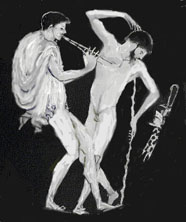
|
When the
god of music, dance and drama is being
restored under the guise of "new wine in a new
wineskin" it is because that specific tribe of illegal preachers trained in
phylosophy and the theater are perhaps lost
beyond redemption and keep the music loud and
long to help them forget or to give them
confidence like whistling through the
cemetary:
"It is
symptomatic of structures
that have lost their elasticity, becoming too rigid to accommodate further
development, to intensify the semantics of self-reference
as a sort of final act of self-reassurance.
"The
patterns of self-reference by drama to drama as we see them in
The Bacchae of Euripides reflect a crisis in the very genre of
tragedy,
in the context of drastic
changes in Athenian society toward the
end of the fifth century;
the prospect is one of abrupt confrontation and
loss." --
Nagy, Pindar's Homer p. 388
In the
recapitulation or "drama" of the ancient
wineskin religion of Dionysus, the symptom of
the "end of the millenium bug bite" proves that it is those promoting
singing, playing, dancing and drama in an
attempt to "move into the presence of the
gods" who are (1) focussed upon
self-reference, (2) experience millenial
nervousness that the "now but not yet kingdom"
cannot be found and (3) experience the
prospect of confrontation and loss.
These are the very people
who have constructed a new wineskin out of
an old, died-of-itself billy goat skin. It
will not stretch enough to fit the "water of
the Word" which Christ put into
"ceremonially pure vessels of clay."
Scholars of drama, ancient and
modern, are quick to admit that when people --
especially males -- put on the masks of drama
there is a real and present danger of gender-leakage or gender
crossover. This, too, is consistent with the
Dionysus tragedy. In
the old form of Dionysus worship, the king doesn't recognize the god of wine as his
cousin and:
"His
initial sense of unfamiliarity gives way to
invasive feelings of familiarity, of maddening closeness. Repulsion gives way to fatal attraction. The magnetic
force of this attraction is the
essence of Dionysos as the god of
theatre, as
the inner source of tragedy itself. It is
the lure of tragedy that draws Pentheus into
his own fatal ordeal. The tragic is what
causes Pentheus to desire to be tragic.... The wonders
of the god Dionysos pull people together to
celebrate these wonders by competing with each other in song and dance.
"The
speech of the herdsman says it all: "once
upon a time, we humble herdsmen came together in the
countryside, drawn by the wonders of the
god to sing and dance in competition."
Of course,
such assemblies for song, dance and drama are
actually ritual combat: the little hills
trying to rise above the mountains in polemic
combat -- everyman's
Armeggedon if you will:
"There is
a single Greek word for such coming together
and competition, agôn. The word means, literally,
"coming together." In the same breath, it
means "competition," since any coming together is of and
by itself the same thing as competition. Nietzsche understood this
fundamental equation in ancient Greek song
culture when he spoke of the "spirit of
Agôn," der agonale Geist. The spirit of
competition is reflected in a derivative of
this Greek word agôn, antagonism.
It is also
true that the word for weapon and instrument
in both Hebrew and Greek are the same. A
carnal weapon is really a carnal musical
instrument which is a lifeless musical
instrument. Therefore, as in most of the
Psalms "with an instrument" or "to the musical
director" the writer -- often David -- is
doing verbal combat with his personal enemies
even singing for God to kill little babies.
However, after Christ came to end the Baal -
Yahweh (prophets of Baal and Asherah versus
Elijah):
"Then to
all mankind He calls out, 'Let every spirit praise the Lord,' because He rules over every spirit He has made. In
reality, man is an instrument for peace, but these other things,
"if
anyone concerns himself overmuch with
them, become instruments of
conflict,
to inflame the passions.
"The
Etruscans, for example, use the trumpet for war; the Arcadians, the
horn; the Sicels, the flute; the Cretans, the lyre; the Lacedemonians, the pipe; the Thracians, the bugle; the Egyptians, the drum; and the Arabs, the cymbal.
"But as for us, we make
use of one instrument alone: only the
Word of peace by whom we a homage to God,
no longer with ancient harp or trumpet or
drum or flute which those trained for war employ." (Clement of
Alexandria, 190AD The instructor, Fathers
of the church, p. 130)
Many poor
males believe that they can hire a
"manipulator" to bring the audience into the
presence of God. And one poor female creature
believes that her dance team is the mediator between God and the audience:
"When we dance we become the platform upon
which God lands."
-
-
"As
dancers we have a
calling to be signs and symbols to the
people of God and to the
world. We are to manifest
His character in every
step that we dance and
every gesture that we
make.
-
- In our priestly
duties as dancers we have
an incredible
respo(n)sibility.
- We not
only bring the offerings of the
people to God,
but as we dance we
also
- provide
a platform
for God to step
down upon in
order to touch His
people with His presence....
-
- I see us as a bridge between
God and man, and
bridges do get walked
upon! So if we are to be
anointed vessels
of honor used
for His glory, then we
must not shy away from
the fiery trials of purification that
will surely come our
way. As our lives are,
so will our dance be! Please
Click Here Before
You Endanger Your
Soul.
|
-
This is identical to the
ancient "Helio-port" at the top of the
Tower of Babel or the Zoe-Sophia team or
neo-pagan purification rituals or the
Dionysus chorus which was often
restricted to real women:
-
- "The backdrop to
the central figures of Pentheus and
Dionysos is the chorus of The Bacchae, female devotees of the god. The word
bakkhos (masculine) or bakkh
(feminine) designates someone who
has been possessed by the god, who
literally has the god within. (The
word entheos,
meaning "having the god [= theos]
within," is the ultimate
source of our word enthusiasm.
(Philo called it en thuso mania and Paul called it
madness. ks) The feminine plural of
this word, bakkhai, is Latinized as
"bacchae," whence the name of
the tragedy, Bacchae.
-
- The play is
named after the chorus,
that is,
- the song-and-dance
ensemble
who stand
for
the true followers
of the god.
"These women
(whatever their gender ks) are
Lydians and hence foreigners, accompanying Dionysos as he travels all the way from
distant Lydia to the center of
Hellenism, Thebes. Their
possession by the god is benign, unlike of the women
of Thebes, who are led by Agave,
mother of Pentheus.
Any time you see a "musical
worship team" or anyone standing over
(rather than sedentary as Paul demanded) you
know that they feel that you are not competent to move into
the presence of God by yourself. However, they are competent -- for a price,
always for a price. This gives rise to the
Musical Worship Minister or the Worship Facilitator (manipulator) in the Jubilee
99 scheme of things. These people on the
dole without authority can load the backs of
the congregation with another buddy who has
no shame and goes on the dole -- replacing
Christ. One mediates in one direction by
bringing his words to replace Christ's
words; the other mediates by lifting or
"ascending" the audience into the presence
of god. A scam what am, eh what!
Jubilee 98 featured a benign mediating team. However, their name is not
unlike the violent Bacchae:
Halal (h1984)
haw-lal'; a prim. root; to be clear (orig.
of sound, but usually of color); to shine;
hence to make a show, to boast;
and thus to be (clamorously)
foolish; to rave; causat. to celebrate; also to stultify: - (make) boast (self), celebrate,
commend, (deal, make), fool (- ish, -ly),
glory, give [light], be (make, feign self)
mad (against), give in marriage, [sing, be
worthy of] praise, rage, renowned,
shine.
Seeing the hand waving,
prancing across the stage under the shadow
of four Asherah poles, from the remoteness
of my computer screen, Jubilee 98 looked
like a halal event which is identical to a
last-stage
Dionysus event. Trying to mediate for the
"audience" or to elevate self up to "stand
over" (not sedentary) in violation of Paul's
command is taking on the role of Lucifer.
Lucifer got his name from the praise teams
of lost Jews:

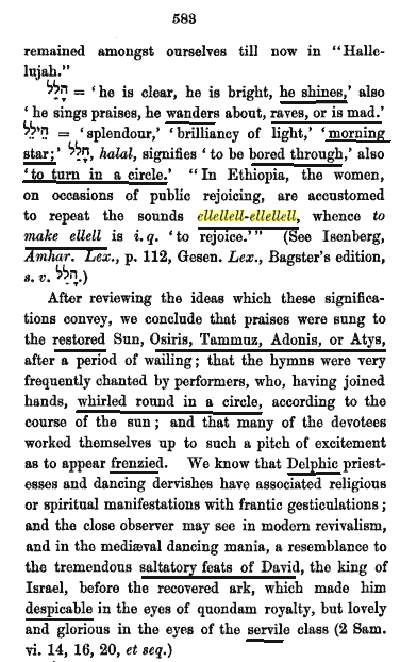
Heylel (h1966)
hay-lale'; from 1984 (in the sense of
brightness); the morning-star: - lucifer.
Thy (Lucifer's) pomp is brought down to the
grave, and the noise of thy viols: the worm (maggots wearing
purple robes) is spread under thee, and
the worms cover thee. Isaiah 14:11
How art thou fallen from
heaven, O Lucifer, son of the morning!
how art thou cut down to the ground,
which didst weaken the nations! Isaiah
14:12
For thou hast said in thine
heart, I will ascend into heaven (to mediate
and accept worship with his musical
instruments), I will exalt my throne
above the stars of God: I will sit also upon the mount
(har as in har-meggido) of the
congregation, in the sides of the
north: Isaiah 14:13
I will ascend above the
heights of the clouds; I will be like
the most High. Isaiah 14:14
(The king of Tyre as a
Lucifer type sang his song of the
prostitute with the harp because he
wanted to be remembered -- as a male)
Lucifer (from halal) would sit at the high
places (surrounded by asherah poles) of
the congregation. Congregation is:
Mowed (h4150) mo-ade'; (2 Chron.
8:13), mo-aw-daw'; from 3259 (to give
in marriage); prop. an appointment, i.
e. a fixed
time or
season; spec. a festival; conventionally a year; by implication, an assembly (as convened for a
definite purpose); technically the
congregation; by extension, the place of
meeting; also a signal (as appointed
beforehand): - appointed (sign, time),
(place of, solemn) assembly,
congregation, (set, solemn) feast, (appointed, due) season, solemn (-ity), synagogue,
(set) time (appointed)
This is why the trumpets or
loud rejoicing were absolutely outlawed for
the assembly of the congregation. Alarm is:
Ruwa (h7321) roo-ah'; a prim.
root; to mar (espec. by breaking); fig. to
split the ears (with sound), i. e. shout (for alarm or joy): - blow an alarm, cry
(alarm, aloud, out), destroy, make a joyful noise, smart, shout (for joy),
sound an alarm, triumph.
The "musical children" or the
Jewish clergy tried to force Jesus into the
feminine or effeminate Greek chorus to lament. This would have had
Heylel triumph over Jesus. However,
Psalm 41 identifies the center of the effort
against Jesus as Judas whose bag was "for
carrying the mouthpieces of wind
instruments).
This triumph, like that
forbidden in the Israelite congregation,
was:
Thriambeuo (g2358) (mean. a noisy iambus, sung in honor of Bacchus); to make an acclamatory procession, i.e. (fig.) to conquer or (by Hebr.) to give victory: - (cause) to triumph
(over).
"Narrative poetry was written
for rhythmical
recitation,
or chant, with instrumental accompaniment; and Lyrical poetry for
rhythmical melody, or singing. It must be
borne in mind that in ancient music--which
in this differs widely from modern--the
rhythm of the melody was identical with
the rhythm of the text. The lyric poetry
was to be sung; the poet was musician and
composer, as well as author. To this day a
poet is said conventionally to "sing." Allen and Greenough Latin
Grammar 609.e
For 'tis thy friends that
make thee choke with rage. Aristotle,
Politics.
For brothers'
wars are
cruel, and They that too deeply loved,
too deeply hate.
Of course, Dionysus or Bacchus was recognized as a
representative or presence of Satan
or Lucifer. He was antichrist
because he took the worship which should
never be given to a musical worship team or
a "preacher of note." The illustration below
represents the end-time rituals of those who
began as simple "musical worship teams."
However, if we understand those men given to
drama we will understand---

Heard the drums and pipes at Jubilee
98 around what looked like Asherah
Poles. Lots of hand waving -- by the
men.
According to
Plato, when women were allowed to
participate in the rituals it was the
ultimate put-down. By picking a token musical worship team who would be the stand
in for all of the women, the rest
were consigned to the audience. The lesson
of the Dionysus, wineskin revival is that
when you fail to recognize the true God,
He sends you strong delusions so that you
believe a lie. You then turn from the
Biblical text as the only source of sermon
and song. The last and most visible sign
which God always sends is to turn you to
feminine and effeminate song, dance and
drama. The result is not spirituality but,
in the whole theatrical world, the
familiarity and close association results
in gender-crossover: the male music
minister runs away with the male organ
player (a true story). A little knowledge
of this ancient form of pretend worship
would make any literate person blush and
"turn in their key to the executive
bathroom."
It was
recognized that before the performers of
musical rituals ascended to the stage they
had already fallen into a form of madness
or frenzy. That is, they were "out of
themselves." How else could you account
for grown men swaying, smiling, waving
hands, nodding, winking and "speaking" in
a totally unnatural voice while pretending
to be in the presence of the God of the
universe and speaking to Him on behalf of
the incompetents? These people cannot
grasp that God is an "adult" and is
capable of hearing us in just plain
english prose. They have to be mad! That
is what halal means!
"The
frenzied excesses of the Theban women
are contrasted with the moderation of
the Lydian Bacchae. Their positive possession belongs in the sphere of
ritual,
which highlights the
moderation that the god can give
mortals who recognize his true
nature.
"The
negative possession of the Theban women
belongs in the sphere of myth, which
contrasts the frenzied excesses experienced by those who fail the challenge of
recognizing the god.
The singing and dancing of
the chorus of Bacchae, who
stand for the Lydian women, is fundamentally an act
of ritual, of worshipping the god.
"This
ritual of bacchic moderation is predicated on the myth
of bacchic catastrophe (homosexual familiarity
from gender
crossover
during song, drama and dance). Such a
balance of moderation and catastrophe brings to life the theatre
of Dionysos.
"One of
the greatest of all Greek dramas, The Bacchae powerfully dramatizes the
conflict between the emotional and rational sides of the human psyche. (See
Romans 7 and 8 to see that Paul
understood this conflict)
- When the people
of Thebes deny the existence of the
god Dionysos,
- he punishes them by unleashing the
full force of female sexuality,
- thereby
destroying social order and
driving them to certain tragedy.
This
conflict between moderation and excesses:
between the emotional and rational sides
of the brain is yearly fought out in
little Jubilee festivals all over the
world. This deliberate conflict is caused
by the failure to understand the true
nature of God in the face of Jesus Christ
and the nature of His "in your heart"
kingdom. The punishment for this failure
is a religion of song, dance, drama and
secular preaching.
Mysticism
Defined - John MacArthur
"Mysticism
includes the idea that direct knowledge of
God or ultimate reality is achieved
through personal, subjective intuition or
experience apart from, or even contrary
to, historical fact or objective divine
revelation."
"Johnson,
a professor at West Texas State
University, elaborates: When we speak of
a mystical experience we refer to an
event that is completely within the person. It is totally
subjective . . . Although the mystic
may experience it as having been triggered by occurrences or objects
outside himself (like a sunset, a piece
of music, a religious ceremony, or even a sex act), the mystical
experience is a totally inner event. It
contains no
essential
aspects that exist externally to him in
the physical world . . . A mystical
experience is primarily an emotive event, rather
than a cognitive one . . Its predominant
qualities have more to do with emotional
intensity, or 'feeling tone' than with
facts evaluated and understood
rationally. Although this is true, it
alone is a woefully inadequate way of
describing the mystical experience. The
force of the experience is often so
overwhelming that the person having it
finds his entire life changed by it.
Mere emotions cannot effect such
transformations.
"Furthermore,
it is from this emotional quality that
another characteristic results,
namely, its 'self-authenticating' nature. The mystic rarely questions
the goodness and value of his
experience. Consequently, if he
describes it as giving him
information, he rarely questions the
truth of his newly gained "knowledge".
It is this claim that mystical
experiences are "ways of knowing"
truth that is vital to understanding
many religious movements we see today.
[Our Sufficiency in Christ, John
MacArthur, Jr., Word Publishing, 1991]
The newly
released book by Travers and Jewel van der
Merwe, "Strange Fire: The Rise of Gnosticism in
the Church" provides us a detailed
explanation of the Gnostic heresy and how
it has adapted to the modern church in
various new perversions of doctrine.
"When a
high value is placed on personal
experiences or revelations, Scriptures
are then unscrupulously
twisted and misquoted. We find those who believe
the feelings of a congregation must be hyped-up in order to `feel' the
Presence of the Lord or else the church is
thought to be `dead.' Instead of music being used to worship and
glorify God, it is
used as a means of `connecting'
or `feeling' the Presence of God. (p. 89)
"Could
Promise Keepers be adopting some of
these `experiential' Gnostic beliefs and practices?
Chris Corbett noted, in the "Heritage"
article, that "given PK's emphasis on
emotional highs and revelations, and
their apparent disdain for precise
theology, critics wonder where
the next `vision' could take the
movement - and how it could influence
the lives of the Christian men being
tethered to it through PK's growing
arms." Unfortunately, Corbett found
that "PK officials would not comment
on the Vineyard..."
Rise of
Gnosticism's Revival With Music
When Paul
condemned an ancient form of gnosticism in the church at Corinth he
was not condemning knowledge of the Bible.
Rather, he was condemning knowledge or
insights which came from mental
intoxication from real wine or
music-induced rituals which brought one
into contact with the gods by being in contact with his
key agents:
"A key
component of the Gnostic experience is
the alteration
of consciousness. Because the Gnostic is
subjectively driven, the perception of
God becomes something that hinges on
feelings rather than faith. In order to
improve upon the feelings, the use of
additional mechanisms to create moods, especially
the use of music, is frequently brought in.
Van der Merwe's explain:
"Worship
is an integral part of the Christian
faith. Sometimes feelings of ecstasy
are experienced. The Presence of God
is rightly acknowledged by true worship.
However,
when emotional
feelings become the doctrine of
God's Presence, then God has been
reduced to a "gnosis" form of Presence. For
many, the doctrine of `knowing the
Presence of God' is sought in a
subjective experience. An emotional
experience, especially a repetitive one during a worship
service, if not kept in proper
perspective or check, can lead to an altered state of consciousness in
which the capacity for rational
reasoning is greatly reduced.
At
this point the congregation is open to delusion and can easily be led
astray. In many charismatic groups
an altered state of mind is
explained as `getting into the
Spirit' or as a manifestation
of the
presence of God. Uncontrolled
spiritual feelings transcend sound
scriptural rationalism and give rise
to the doctrine of `the Presence of God' built on experience.
(p. 90-91, "Strange Fire")
The almost
frantic running to and fro learning the
latest methods of mind control through
song, instruments, dance and weird
preaching may be an end-time loss of faith
in the revealed Christ. Many of these
people believe that they are the revealers
of a new paradigm or "wineskin" into which
all of the world's religions will fit.
Short of actual morphine and alcohol,
music is the next best alternative to
alter the minds of the "worshippers" to
make them feel certain things and thereby
validate the new "Jesus."
"For
instance, Pastor Ryle believes his
dreams and visions are prophetic revelations directly from God. In a
sermon entitled "Sons of Thunder" he
preached at his church, Boulder Valley Vineyard in Longmont, Colorado,
July 1, 1990, he alleges that God is about to anoint
Christian musicians with the same "anointing"
that was originally given to the
Beatles. He says God told him in a
dream:
"I called
those four lads from Liverpool to
myself. There was a call from God on
their life; they were gifted by my hand;
and it was I who anointed them, for I
had a purpose, and the purpose was
to usher
in the charismatic
renewal
with musical
revival around the world." RESURRECTING PAGAN
RITES
The revival of pagan myths and rites
includes the reintroduction of the Sacred
Prostitute concept for women. Part 2: THE SACRED
PROSTITUTE (From the December 1995
issue of Christian Conscience
magazine)
"Sacred"
prostitution and sacred music have always
been a matched pair. In the modern church
the incidence of consumated "worship" is
probably small. However, the "promise" and hope is implicit in the choice of
talent, beauty and dress. Paul understood
that the "stand up - speak up" role for
women would be an open admission of her
devotion to body and talent and not to God
Who is Spirit and does not need
entertainment. According to Plato when
women were permitted in these roles it was
actually a show of contempt
Albert
Barnes and the Wine Music Connection
When the
mind becomes dull from taking the alcohol
drug, the tavern keeper knows that he can
arrouse you with loud music or a stand-up commedian.. However, this allows you
to get drunker and the booze merchant gets
richer. You are not only under the control
of the alcohol drug but also the music
drug:
"The music
was designed to counteract the effects
of inebriety; for as wine discomposes the body
and the mind, so music has the power of
soothing them, and of restoring their
previous calmness and tranquility."
(Barnes quoting Plutarch, Isaiah p. 129)
The music in
the taverns injects other drugs which
keeps the customer alert and drinking.
Remove the music and you just have the
drunks. If you want them to return you had
better have the best entertainment in
town. This also describes the ancient
pagan temples. In the end, the
"excitement" from both wine and music
produced withdrawal symptoms when the
drugs quit flowing--usually before Sunday
night services.
It is also
useful for "dumb, dirty, ignorant sheep"
or for the mentally deranged like Saul.
Researchers have discovered that the low,
bass tones can nail your seat to the pew
while the high, female or effeminate
voices can create great anxiety which
makes you want to run for your life. The
combination of LF/HF can physically,
emotionally and mentally derange and then
kill.
Job and
Musical Star Worship
Of those
addicted to star worship where music
helped you up the steps of the Towers of
Babel, the book of Job notes the
connection between music and telling the
ethical God to get lost:
They send
forth their little ones like a flock,
and their children dance. Jb 21:11
They
take the timbrel and harp, and rejoice
at the sound of the organ. Jb 21:12
They spend their days in wealth, and
in a moment go down to the grave. Jb
21:13
Therefore
they say unto God, Depart from us;
for we desire not the knowledge of
thy ways. Jb 21:14
This, of
course, explains a form of astrology where
fertility was the result of song and dance
while telling God to get lost. And this is
the reality in most songs and sermons. The
discovery of the stretched string was
believed to be magic and that the gods or
demons actually lived within musical
instruments. How else could you account
for the deranged feelings which allowed
the soothsayer (preacher) to echo her own
voice from an old wineskin and prove to
you that it was the presence of the gods.
Jubilee 99 will feature an expert on Chage
Agentry to life up the Name of the Lord
when He said that He is lifted up in
"righteousness and justice." The methods
of change are, too, ancient paganism.
"Farther
still, the whole Pythagoric school produced by certain appropriate songs, what they called
exartysis, or adaptation; synarmoge, or elegance of manners; and epaphe, or contact,
usefully conducting the
dispositions of the soul to passions contrary
to those which it before possessed.
"For when
they went to bed, they purified the
reasoning power from the perturbations
and noises to which it had been exposed
during the day, by certain odes and peculiar songs, and by this means
procured for them tranquil sleep, and
few and good dreams.
"But when
they rose from bed, they again liberated
themselves from the torpor and heaviness
of sleep, by songs of another kind.
Sometimes, also, by musical sounds alone, unaccompanied with words,
they healed the passions of the soul and
certain diseases, enchanting, as they say, in
reality....After this manner, therefore,
Pythagoras
through music produced the most beneficial
correction of human manners and lives.
Iamblichus (300 A.D.)
"The
true, highest melody, however, is that
which is sung
without any voice. It resounds in the interior of man, is vibrating in his heart
and in all his limbs. Isaac Loeb Peretz
(1912).
"A
certain number of musicians were gathered at a feast given by a great sovereign who took care to place
them
according to their degree
of mastery of
their respective arts,
"when a
man of wretched appearance, clad in
rags, entered. The master of
ceremonies raised him up above all the
participants, whose faces expressed
their evident disapproval. Wishing to
display the man's merit and calm his
guest's anger, the master asked him to
let them hear a sample of his art.
"He took
out some pieces of wood which he had
with him, set them out before him and
stretched strings over them. Then he set these
strings vibrating and performed an air that made all those
present burst
into laughter because of the
pleasure, the joy and the
well-being that took possession of
their souls.
"Then he changed his tuning
and played another air which made
everyone weep for the tenderness of
the melody and the sadness which
settled in their hearts.
Then he changed the tuning,
and played another air which plunged everyone into
slumber;
so doing he rose, went out and was
never heard spoken of again. (The Brethren of Purity
of Basra )
Isaiah
and Israel's Wineskin Musical Worship
The best
possible negative model of the new wine
and music revival of paganism is in Isaiah
five. God had provided them with
everything but the people neglected God's
"vineyard" and turned to daily religious
festivals:
Woe unto
them that rise up early in the morning,
that they may follow strong drink; that continue until
night, till wine inflame them Isa 5:11
(Note: this is contaminated wine or
grain beer which has natural or added
hallucinogens. A high level of
music-induced endorphins can also cause
hallucinations.)
And the
harp, and the viol, the tabret, and pipe, and wine, are in their feasts:
but they regard
not
the work of the Lord, neither consider
the operation of his hands. Isa 5:12
Therefore
my people are gone into captivity,
because they
have no knowledge: and their honourable
men are famished, and their multitude
dried up with thirst. Isa 5:13
Therefore
hell hath enlarged herself, and
opened her mouth without measure:
and their glory, and their
multitude, and their pomp, and he that rejoiceth, shall descend into
it. Isa 5:14
Ancient writers called this
"intoxicated on pure ignorance." When you
are dealing with those drunk on ignorance
and even worshipping it you are not dealing
with rational minds. Therefore, note with
care that these "pacifists will kill you"
for trying to feed them the Words of Christ.
Ritual murder is much more politically
handled than when the prophets warned Saul
and David.


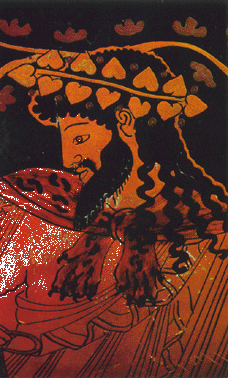

 t
t 