JEFF NELSON HIGHLAND
MELODY DECEIVES
CLICK BELOW: SONGS AND SERMON AND
PROGRAMS AND FLEECING CANNOT TOUCH GOD'S SAFE HOUSE.
CLICK BELOW: THE MARK OF THE BEAST
IS ANY MUSIC INVADING JESUS' SCHOOL OF THE WORD ONLY
CLICK BELOW: LOST
SPIRIT-PILGRIMS IN SATAN'S WORLD OF ABORIGINES CANNOT HEAR.
CLICK BELOW: SAM SOUDER CLAIMS TO BE
SUPERIOR TO GOD
CLICK BELOW: REPLACING
GOD AND JESUS THE CHIEF SHEPHERD
CLICK BELOW: BRANDON
SCOTT THOMAS THE HOLY SPIRIT IS LEADING US
CLICK BELOW: WORSHIP
LEADERS LIE ABOUT EPHESIANS 5
CLICK BELOW: SINGING RATHER
THAN SPEAKING GOD'S WORD IS A UNIVERSAL MARK OF BURNING.
CLICK BELOW: SIMON THE SORCERER USED BOTH
VOCAL AND INSTRUMENTS
CLICK BELOW: SCRIPTURE
AND HISTORICAL DOCUMENTS: METER OR MELODY INTENDS TO
DECEIVE.
SONGS AND SERMON AND PROGRAMS AND
FLEECING CANNOT TOUCH GOD'S SAFE HOUSE
Jeff, based on Holy Scripture Earth is the arena occcupied
almost totaly by dust or ABORIGINES and the HEAVENLY arena
occupied by a small COVERT or Church as Safe House..
ALL SONGS AND SERMONS ARE PURPOSE DRIVEN TO MAKE THE LAMBS
DUMB BEFORE THE SLAUGHTER
https://www.pineycom.com/Isaiah.4.The.Branch.of.the.Lord.html
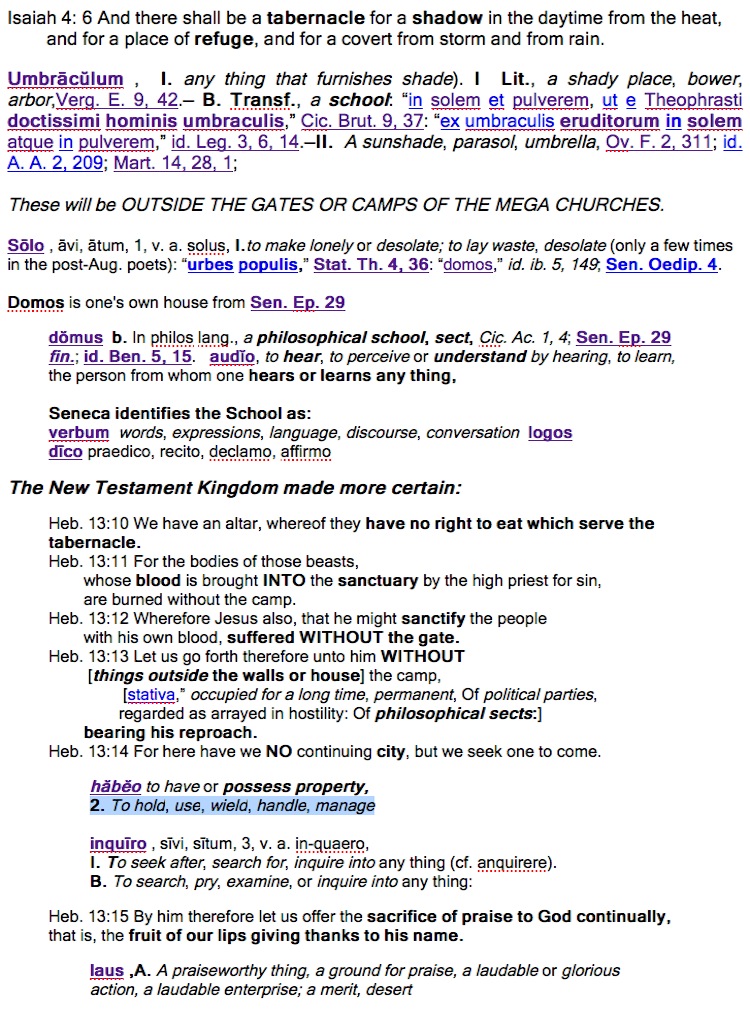
LOST SPIRIT-PILGRIMS
IN SATAN'S WORLD OF ABORIGINES CANNOT HEAR.
No man can come to me,
............ except the
Father which hath sent me DRAW HIM
............ and I will
raise him up at the last day. John 6:44
How does God DRAW people?
It is written in the prophets,
............ And they shall be all taught BY God.
............ Every man
therefore that hath heard,
............ and hath learned of the Father,
............ cometh unto me.
John 6:45
John 6:62 What and if ye shall see the
Son of man ascend up where he was before?
John 6:63 It is the SPIRIT
that quickeneth; the flesh profiteth nothing: the WORDS
that I speak unto you,
they are spirit, and
they are life.
John 6:64 But there are some of you that believe not.
For Jesus knew from
the beginning who they were that believed not,
and who should
betray him.
John 6:65 And he said, Therefore said I unto you,
that no man can come
unto me, except it were given unto him of my Father
Jeff Nelson Highland Melody Deceives
New Living Translation
As it is written in the Scriptures, ‘They will all be
taught BY
God.’ Everyone who listens to the Father and
b comes
to me.
English Standard Version
It is written in the Prophets, ‘And they will all be
taught BY God.’ Everyone
who has heard and learned from the Father comes to me—
Berean Standard Bible
It is written in the Prophets: ‘And they will all be
taught BY God.’ Everyone
who has heard the Father and learned from Him comes to Me—
Holman Christian Standard Bible
It is written in the Prophets: And they will all be
taught BY God. Everyone
who has listened to and learned from the Father comes
to Me—
New American Bible
It is written in the prophets: ‘They shall all be
taught BY God.’ Everyone
who listens to my Father and learns from him comes to me.
NET Bible
It is written in the prophets, 'And they will all be
taught BY God.' Everyone
who hears and learns from the Father comes to me.
New Revised Standard Version
It is written in the prophets, ‘And they shall all be
taught BY God.’ Everyone
who has heard and learned from the Father comes to me
THE SEAL GOD GIVES:
Acts 2:41 Then they that gladly received his WORD
were baptized: and the same day there were added unto them
about three thousand souls.
THE MARK OF THE
BEAST IS ANY MUSIC INVADING JESUS' SCHOOL OF THE WORD ONLY
The.Mark.of.The.Beastia.html
When
Nahash (the name must be an Israelite
caricature: it means “snake”), the king of the
Ammonites, agreed to spare the Israelites of
Jabesh-Gilead only if the Israelites allowed Nahash to gouge
out the right eye of every man by the soon-to-be
king of the Israelites, King
Nachash was no snake. He was, perhaps, a smelter
of copper (or an importer of copper from the lands to
the south of Ammon), perhaps a soothsayer or diviner,
perhaps simply a smart man.
Gen. 3:1 Now the SERPENT
was more SUBTIL than any beast of the field
which the LORD God had made. And he said unto the
woman, Yea, hath God said, Ye shall not eat of every
tree of the garden?
h5175.
נָחָשׁ nachash, naw-khawsh´; from 5172; a snake
(from its hiss):—serpent.
h5172. נָחַשׁ nachash,
naw-khash´; a primitive root; properly, to hiss,
i.e. whisper a (magic) spell; generally, to
prognosticate:—x certainly, divine, enchanter,
(use) x enchantment, learn by experience, x
indeed, diligently observe.
Serpo
, of things, to
move slowly or imperceptibly,
to creep along, proceed gradually,
Of disease, etc.: “si ulcus latius atque altius serpit,” gradually
spreads, “serpentes quasdam (bestias), quasdam esse gradientes,”
“chamaeleon,
Fire: “exsistit sacer ignis et urit corpore serpens,” slowly
spreading, canam, qui leniter (cf.: “sermones Repentes per humum,”A creeping
LOUSE
căno , cĕcĭni,
cantum (ancient I.imp. cante = canite,
Of instruments or a piece of music, to sound,
resound, be played: canentes tibiae: tubae Liberum et Musas,
“once canituri,” Vulg. Apoc. 8, 13
to utter melodious notes, to sing,
sound, play.
tibicen “cithara,”
crowing of a cock: “galli victi silere solent, canere victores,” to crow,
to practice magic, to charm,
Galli is a word for a Catamite: priest of
the Mother Godesses.
Mousa
“kanakhan [CLANGING
BRASS]. . theias antiluron mousas” S.Tr.643
(lyr.); “Aiakō moisan pherein” “adein adokimon m.”
“adein
adokimon m.” 3.
disreputable, “lakismat' adokim' olbiois ekhein” E.Tr.497;
“mousa” Pl.Lg.829d,
cf. D. 25.36,Ep.Rom.1.28
SUBTIL Callĭdus , a, um,
adj. calleo, I.that is taught wisdom by
experience and practice, shrewd, expert,
experienced, adroit, skilful:
“in disputando,” Quint. 12, 2, 14
In reference to art, excelling in art, skilful,
Hor. S. 2, 3, 23
— rĕ-sŏno
callida Musa, Calliope
Hor. Od.
1.10
tuque
testudo
resonare septem
Callida
nervis,”
id. ib. 3, 11, 4; Pers. 1, 118.—
Tac. Ann.
14.14
He had long had a fancy for driving a four-horse
chariot, and a no less degrading taste for singing
to the harp, in a theatrical fashion, when he was at
dinner.
This he would remind people was a royal custom, and had
been the practice of ancient chiefs; it was celebrated
too in the praises of poets and was meant to show
honour to the gods. Songs indeed, he said, were
sacred to APOLLON, [cantus Apollini sacros] and it was in the dress
of a singer [femmale garment[ that that great
and prophetic deity was seen in Roman temples as
well as in Greek cities |
Matt. 3:7 But when he saw many of the
Pharisees and Sadducees come to his baptism, he said
unto them,
O generation of
vipers, who hath warned you to flee from the wrath to
come?
Matt. 12:34 O generation of vipers, how can ye, being
evil, speak good things? for out of the abundance of the
heart the mouth speaketh.
Matt. 23:33 Ye serpents, ye generation of vipers, how
can ye escape the damnation of hell?
genn-ēma , atos,
to,
II. Act., begetting,
A.Pr. 850
(pl., s.v.l.).
2.
producing, Pl.Sph.266d.
ekhidn-a , hē, ( ekhis)
A.
viper, Hdt.3.108,
S.Tr.771,
Pl.Smp.218a,
etc.; prob. of a constrictor snake, Act.Ap.28.3: metaph.,
of a treacherous wife or friend, A.Ch.249,
S.Ant.531;
himatismenē e., of woman, Secund.Sent.8;
gennēmata ekhidnōn brood of
vipers, term of reproach, in Ev.Matt.3.7.
|
|
GOD AS HIS WORD OR LOGOS
Theology.Logos.Mythos.Word.Versus.Music.html
Logos,
verbal noun of lego
Opposite
kata pathos
Opposite music, poetry or rhetoric
Opposite
human reasoning
Opposite
Epagoge bringing in to one's aid, introductionAlurement, enticement, incantation,
spell
Opposite
Pathos A.
that which happens to a person or thing, incide4.speech,
delivered in court, assembly
VI. verbal expression or utterance,
lego, lexis
-Lexis
A.speech, OPPOSITE ôidê
-ôidê,
1.art of song 5. = eppsdê, spell,
incantation
4. text of an author, OPPOSITE exegesis
[Peter's private interpretation outlaws exegesis]
Arist.En1142a26
Girardian Lectionary
45. The Greek verb myo
means to close the mouth or shut the eyes.
There is debate about whether myo plays a
crucial role in the etymology of other significant
words such as myth, mystery, and
even music. These etymologies make sense
within the Girardian hypotheses. Myth means to
close ourselves to the victim and tell the tale
according to the perpetrator's perspective; mystery
cults are based on the silence of the victims;
music derives from drowning out the voice of the
victim.
|
John 8:42 Jesus said unto them, If
God were your Father, ye would love me: for I
proceeded forth and came from God; neither came I of
myself, but he sent me.
John 8:43 Why do ye not understand my speech? even
because ye cannot hear my word.
John 8:44 Ye are of your father the devil, and the lusts
of your father ye will do. He was a murderer from the
beginning, and abode not in the truth, because there
is no truth in him. When he speaketh a lie, he
speaketh of his own: for he is a liar, and the father
of it
Mark 4:9 And he said unto them, He that hath ears to
hear, let him hear.
Mark 4:10 And when he was alone, they that were about
him with the twelve asked of him the parable.
Mark 4:11 And he said unto them, Unto you it is given to
know the mystery of the kingdom of God: but unto them
that are without, all these things are done in parables:
Mark 4:12 That seeing they may see, and not perceive;
and hearing they may hear, and not understand; lest at
any time they should be converted, and their sins should
be forgiven them.
Mark 4:13 And he said unto them, Know ye not this
parable? and how then will ye know all parables?
Mark 4:14 The sower soweth the word.
Mark 4:15 And these are they by the way side, where the
word is sown; but when they have heard, Satan cometh
immediately, and taketh away the word that was sown in
their hearts.
|
Jude 1 Jude, the
servant of Jesus Christ, and brother of James,
to them that
are sanctified by God the Father,
and preserved
in Jesus Christ, and called:
Jude 2 Mercy unto you, and peace, and love, be
multiplied.
Jude 3 Beloved, when I gave all diligence
to write unto
you of the common salvation,
it was
needful for me to write unto you,
and exhort you
that ye should earnestly
contend for the faith which was
once delivered unto the saint
Jude 4 For there are certain men crept in
unawares,
who were before of old ordained to this
condemnation,
ungodly men,
turning the grace of our God into
lasciviousness,
and denying
the only Lord God [Theos], and our Lord
[Kurios] Jesus Christ.
THIS HAPPENED WITH THE PROPHESIED RESULTS
North.Boulevard.Church.of.Christ.Elders.Vision.htmlJ
Jude 5 I will therefore put you in remembrance,
though ye once knew this,
how that the
Lord, having saved the people out of the land of
Egypt,
afterward
destroyed them that believed not.
|
|
Ex.
32:6 And they rose up early on the morrow, and
offered burnt offerings, and brought peace offerings;
and the people sat down to eat and to drink, and
rose up to play
Ludo A. To
sport, play with any thing, to practise as a
pastime, amuse one's self with any thing, B.
To sport, dally, wanton Esp., to play
on an instrument of music, to make or compose
music or song:
A. To sport, play with
any thing, to practise as a pastime,
amuse one's self with any thing: “illa ipsa ludens conjeci in communes locos, Cic. Par. prooem.: Prima Syracosio dignata est ludere versu Nostra ... Thalia,” Verg. E. 6, 1.—Esp.,
to play on an instrument of music, to
make or compose music or song:
1Cor. 10:7 Neither be
ye idolaters, as were some of them; as it is written,
The people sat down to eat and drink, and rose up
to play.
Paizō pais
I. properly, to play like a child, to
sport, alla
pepaistai
metriōs
hēmin,
of the chorus, Ar. Th.1227.
4. play on a musical instrument,
h.Ap.206:
“Pan
ho
kalamophthogga
paizōn”
WORSHIP MINISTER dance and
sing, |
Jude 6 And the angels
which kept not their first estate, but left their
own habitation,
he hath
reserved in everlasting chains
under darkness unto the judgment of the
great day.
SEE [3]
Muses,
Muusicians,
Locusts are
unleashed from
HADES.
zophos
, ho,
A. nether
darkness, Aidēs d' elakhe zophon ēeroenta obtained the
realms of gloom for his share,
Haidēs
or hadēs , ou, ho, Att.; Ep. Aidēs , 2.
gen. hadou with nouns in
adjectival sense, devilish, “ thuousan ha. mēter'” A.Ag.1235;
“ ha. mageiros” E.Cyc.397;
fatal, deadly,
mētēr
, Aphrodite of the Loves,
|
|
THIS HAPPENED AT THE
UNIVERSALLY PROPHESIED DATE
Rev. 9:1 And the fifth angel sounded, and I saw a star
fall from heaven unto the earth:
and to him was
given the key of the bottomless pit.
Rev. 9:2 And he opened the bottomless pit;
and there
arose a smoke out of the pit, as the smoke of a great
furnace;
and the sun
and the air were darkened by reason of the smoke of the
pit.
Rev. 9:3 And there came out of the smoke locusts upon
the earth:
and unto them was
given power, as the scorpions of the earth have power.
Antiquity set Apollo as their leader, Apollon
Mousagetēs (
According to
Herodotus, they surfaced some
2,000 years after that as an
effeminate priesthood in
what is now southern Russia and
present-day Ukraine. They were
called the ENAREE, "endowed by the
goddess Venus with the gift of
prophecy."
18
Five hundred years on, they were
holy priests telling the future,
still dressing like women as they
worshipped the mother earth
Nerthus in the cult of the ALCI, the
German version of the gay Twins
CASTOR AND POLLUX.
The variations of the cults that
evolved are infinite and can be
found beneath upwards of thirty or
more of the FOUNDING MYTHS OF
HOMOSEXUALITY in the Greek pantheon
alone. Be they CURETES or KUROI,
they became the later masked SATYRS
and SILENI or THYIADES in the
thesauri rites of the Horned Gods.
Their emphasis on music and dancing,
such as with the BACCHI and TITYRI,
was dotted throughout the land.
As
the islanders were conquered, the human
dancing KUROI were similarly transformed
into deities, first associated with the
gay god APOLLO, then the effeminate
DIONYSOS, and finally as the attendants
at the birth of ZEUS himself. Indeed,
ZEUS came to be known as the "Greatest
of the KUROI," and from these beginnings
came the Cults of ZEUS in which the
worshippers, like the KUROI, came to
feel themselves one with the cosmos as
if struck by a thunderbolt. Yet before
the coming of the patriarchal invaders,
the homosexual KUROI were already spread
far and wide. Originally from Asia
Minor, roughly around where Syria or
Lebanon and parts of old Turkey are
located today, they were carried on the
trade routes between Asia Minor,
Mesopotamia and Egypt.
"Apollo Muse-leader").[9]
Not only are the Muses explicitly used in modern English
to refer to an artistic inspiration,
as when one cites one's own artistic muse, but they
also are implicit in words and phrases such as "amuse",
"museum" (Latinised from mouseion—a place where
the muses were worshipped), "music", and "musing
upon".[10]
A Charmer is an Abomination
https://en.wikipedia.org/wiki/Muses#Cult
As the patron deity of Delphi (Apollo Pythios),
Apollo is an oracular
god—the prophetic deity of the Delphic Oracle. Apollo is the god
who affords help and wards off evil; various epithets
call him the "averter of evil". Delphic Apollo is the
patron of seafarers, foreigners and the protector of
fugitives and refugees.
As the god of Mousike (art of Muses), Apollo
presides over all music, songs, dance and poetry. He
is the inventor of string-music, and the frequent
companion of the Muses, functioning as their chorus
leader in celebrations. The lyre is a common attribute of Apollo. In
Hellenistic times, especially during the 5th century
BCE, as Apollo Helios he became identified
among Greeks with Helios, Titan
god of the sun.[2]
incantātor , ōris,
m. incanto, I. an enchanter,
wizard (post-class.), Tert.
Idol. 9; Isid. 8, 9,
15; Mos. et Rom. Leg. Coll. 15, 1, 2. pythones
consŭlo (a).
In the lang. of religion, to consult a
deity, an oracle, omens, etc.: “Apollinem
de
re,”
Cic. Leg. 2, 16, 40:
“deum
consuluit
auguriis,
quae
suscipienda
essent,”
Liv. 1, 20, 7:
“deos
hominum
fibris,”
Tac. A. 14, 30 fin.:
“Phoebi
oracula,”
Ov. M. 3, 9;
Suet. Vesp. 5:
“Tiresiam
conjectorem,”
Plaut. Am. 5, 1, 76:
B. An incantation, charm,
magic song, etc.: cantusque artesque magorum.
“cantus
e
curru
Lunam
deducere
tentat,”
2. With instruments, a playing,
music: “in
nervorum
vocumque
cantibus,”
Cic. Tusc. 1, 2, 4;
id. Rosc. Am. 46, 134:
“citharae,”
Hor. C. 3, 1, 20:
“horribili
stridebat
tibia
cantu,”
Cat. 64, 264:
“querulae
tibiae,”
|
Matt.
13:39 The enemy that sowed them is the devil;
the harvest is the end of the world; and the
reapers are the angels.
Matt. 25:41 Then shall he say also unto them on
the left hand, Depart from me, ye cursed,
into everlasting fire,
prepared for the devil and his angels:
Angĕlus
, i, m., = aggelos. B.
In mal. part.: “Diabolus et angeli ejus,” Vulg. Matt. 25, 41: “angelus Satanae,”
ib. 2 Cor. 12, 7 al.
Aggelos
2. generally, one that announces or tells,
e.g. of birds of augury, Il.24.292,296; Mousōn aggelos, of a
poet, Thgn.769;
“aggele earos . . khelido
Mousa
, ēs, hē, Aeol. Moisa II. mousa, as Appellat., music,
song, “m. stugera” A.Eu.308
(anap.); “euphamos” Id.Supp.695
(lyr.); “kanakhan . . theias antiluron mousas” S.Tr.643
(lyr.); “Aiakō moisan pherein” Pi.N.3.28;
tis hēde mousa;
Mousa
, Apollyon's Musical Worship
Teams-LocustsDios aigiokhoio thugateres”
[Daughters whatever the sex] |
|
[1]
MUSICIANS
stugeros
A .hated,
abominated, loathed, or hateful,
abominable, loathsome
mousa
music, song, “m. stugera kanakhan
. .1Cor. 13:1 Though I speak with the
tongues of men and of angels, and have not
charity, I am become as sounding brass, or a
tinkling cymbal.
THEIAS
etheiazon obtained
inspiration through
ritual antiluron
responding to the lyre or guitar.
Aoidos , ho, (aeidō) A.singer,
minstrel, bard THEIOS a
Enchanter,
Sorcerer
[2]
MUSICIANS
“adein [singers
are] adokimon mousa
adokimon
disreputable,
discredited, reprobate,
[3] MUSICIANS They
are from Aidēs”
Haidēs
Aidao domoisi
in the nether
world to the nether world, 2. place
of departed spirits,
2. gen. hadou with nouns in
adjectival sense, devilish,
“thuousan
ha. mēter'”
A.Ag.1235;
“ha. mageiros”
thuousan
Silenced in Romans 12 so that
Worship is Spiritual, rational or teaching
the Word, Logos, Regulative Principle only
[4] MUSICIANS are
FOREORDAINED to this JUDGMENT and a "Locusts"
chase the GODLY out.
Jude.There.Should.Be.Mockers.in.the.Last.Time.html
[5] MUSICIANS MOCKED
Worship.Androgyny.The.Pagan.Sexual.Ideal.html
Jeanene.Reese.LGBT.MUST.be.Included.html
[6] MUSICIANS They
Do NOT know God nor Christ
2.John.1.9.The.Doctrine.of.Christ.html
2John 9 Whosoever
transgresseth,
and abideth not in the doctrine
of Christ, hath not God.
He that abideth in the doctrine of
Christ,
he hath both the Father
and the Son |
|
|
Origen
XLI In the next place, as if he had forgotten
that it was his object to write against the Christians,
he says that,
"having become acquainted with one Dionysius,
an Egyptian musician,
the
latter told him, with respect to magic
arts,
that it
was only over the uneducated and men of
corrupt morals that they
had any power,
;
while on philosophers they were unable
to produce any effect,
because
they were careful to observe a healthy
manner of life."
Vulgate translates, Ezek.
33:31 "They turn thy words into a song of their mouths."
heart goeth after covetousness--the grand rival to the love of God;
therefore called "idolatry," and therefore associated with impure carnal love,as both alike transfer the heart's affection from the Creator to the creature.
Is.
29:13 Wherefore the Lord said, Forasmuch as this people
draw near me with
their mouth,
and with their lips
do honour me,
but have removed
their heart far from me,
and their fear
toward me is taught by the precept of men:
Is. 29:14 Therefore, behold, I will proceed to do a
marvellous work among this people, even a marvellous work
and a wonder: for the wisdom of their wise men shall
perish, and the understanding of their prudent men shall
be hid.
Ezek. 33:30 Also, thou son of man, the children of thy
people still are talking against thee by the walls and in
the doors of the houses, and speak one to another, every
one to his brother, saying,
Come, I pray you,
and hear what is the word that cometh forth from the LORD.
Ezek. 33:31 And they come unto thee AS
the people cometh,
and they sit before
thee AS
my people, and they hear thy words, but they will not do
them:
for with their mouth
they shew much love, but their heart goeth after their
covetousness
Psa. 78:36 Nevertheless they
did flatter him with their mouth, and they lied unto him
with their tongues.
Psa. 78:37 For their heart was not right with him, neither
were they stedfast in his covenant.
FLATTER: 6601.
פָּתָה pathah, paw-thaw´; a primitive root; to open,
i.e. be (causatively, make) roomy; usually figuratively
(in a mental or moral sense) to be (causatively, make)
simple or (in a sinister way) delude:—allure, deceive,
enlarge, entice, flatter, persuade, silly (one).
Ezek. 33:32 And,
lo, thou art unto them as a very LOVELY
SONG of one that hath a pleasant voice,
and can play well on
an instrument:
for they hear thy
words, but they do them not.
Ezek. 33:33 And when this cometh to pass, (lo, it will
come,) then shall they know that a prophet hath been among
them
CANTILLATION: The earliest
reference to the definite modulation of the Scripture occurs
in the Babylonian Talmud (Meg. 32a),
where R. Johanan deprecates the indifference of such as "read
[the text] without tunefulness and repeat [the Mishnah]
without song." The use of the term  ("tunefulness") shows that a melody definite enough to cause a
pleasant impression was already attached to the Scriptural
readingzThe earliest reference to the definite modulation of
the Scripture occurs in the Babylonian Talmud (Meg. 32a),
where R. Johanan deprecates the indifference of such as "read
[the text] without tunefulness and repeat [the Mishnah]
without song." The use of the term
("tunefulness") shows that a melody definite enough to cause a
pleasant impression was already attached to the Scriptural
reading
("tunefulness") shows that a melody definite enough to cause a
pleasant impression was already attached to the Scriptural
readingzThe earliest reference to the definite modulation of
the Scripture occurs in the Babylonian Talmud (Meg. 32a),
where R. Johanan deprecates the indifference of such as "read
[the text] without tunefulness and repeat [the Mishnah]
without song." The use of the term
("tunefulness") shows that a melody definite enough to cause a
pleasant impression was already attached to the Scriptural
reading
Psalmos
also appears in the LXX as equivalent to the Hebrew word
neginah. This Hebrew term is used to describe a wide
variety of songs. Neginah is translated by psalmos in Lam
3:14 (song), in Lam 5:14 (music) and in Ps 69:12 (song).
It is striking to observe that in the LXX translation of
Lam 3:14 and Ps 69:12, psalmos, or its verbal form, is
used for songs that are not only uninspired but are in
fact the product of the wicked, even drunkards, who
mocked God and His word. The Hebrew term neginah is
used elsewhere in the Hebrew Scriptures of: the songs
of the wicked, Job 30:9 (song); the inspired praise
of God, Psalm 61 title (Neginah-a song performed on a
stringed instrument); and the uninspired praise of the
Lord composed by King Hezekiah, Is 38:20 (my songs).
"Some of the psalms express a
tribalistic hatred
of foreign powers;
even the beautiful laments of the exiles 'by the waters of
Babylon,' for example, concludes with the assurance that
the daughter of Babylon will be destroyed. 'Happy shall he
be, that taketh and dasheth the little ones against the
stones.'
SAM SOUDER
CLAIMS TO BE SUPERIOR TO GOD
https://www.pineycom.com/Sam.Souder.Apollyon.Worship.Minister.html
SAM: Our role as worship leaders is to MINISTER
to the heart of God Himself
our worship is about
HIM and Him alone.
We also serve to BLESS those who gather for
worship in OUR services,
not so that they can
walk away “satisfied” or “FILLEDBY
THE MUSIC” ,
but so that SPACE
is created for THEM to
encounter the living God.
Acts 17:27 That they should seek the
Lord, if haply they might feel after him, and find him,
though he be not far from every one of us:
Acts 17:28 For in him we live, and move, and have our
being; as certain also of your own poets have said, For we
are also his offspring.
Acts 17:29 Forasmuch then as we are the offspring of God,
we ought not to
think that the Godhead is like unto gold, or silver, or
stone,
graven by art and
man’s device.
But you,
worship leader—you know (or at least you ought to
know) where you are LEADING
them.
Ours is not
a role of “forcing worship” upon OUR people.
It
is merely PROMPTING them OUT
of the sheep pen [A
Church of Christ]
and
into a space where the kingdom of God does its
transformative work within them.
Our job is to merely open the
gate and lead them into GREENER pastures.
Luke.17.Kingdom.Not.Observation.html
Lk 17:20 And when he was demanded of the
Pharisees, when the kingdom of God should come, he
answered them and said, The kingdom of God cometh not
with observation:
paratēr-ēsis
, eōs,
hē,
observation, dieilēmmenoi
eis
paratērēsin
kept under surveillance, so that it can
be observed, Ev. Luc. 17.20
: in bad sense, close observation, to detect faults,
ets
2.. observance of rules,
pathos
[a^,
eos,
to,
(paskhō)
poieō
,
empirical observation, Opposite.
logismos,
so kata
historian
ē
Against Recorded History
John 10:1 Verily, verily, I say
unto you, He that entereth not by the door into
the sheepfold, but climbeth up some other way,
the same is a thief and a robber.
John 10:2 But he that entereth in by the door is
the shepherd of the sheep.
John 10:3 To him the porter openeth; and the
sheep hear his voice: and he calleth his own
sheep by name, and leadeth them out.
John 10:4 And when he putteth forth his own
sheep, he goeth before them, and the sheep
follow him: for they know his voice.
John 10:5 And a stranger will they not follow,
but will flee from him: for they know not the
voice of strangers.
John 10:6 This parable spake Jesus unto them:
but they understood not what things they were
which he spake unto them.
John 10:7 Then said Jesus unto them again,
Verily, verily, I say unto you, I am the door of
the sheep.
John 10:8 All that ever came before me are
thieves and robbers: but the sheep did not hear
them.
John 10:9 I am the door: by me if any man enter
in, he shall be saved, and shall go in and out,
and find pasture.
John 10:10 The thief cometh not, but for to
steal, and to kill, and to destroy: I am come
that they might have life, and that they might
have it more abundantly.
John 10:11 I am the good shepherd: the good
shepherd giveth his life for the sheep.
REPLACING
GOD AND JESUS THE CHIEF SHEPHERD
John 9:37 And Jesus said unto him,
Thou hast both seen him, and it is he that talketh with
thee.
John 9:38 And he said, Lord, I believe. And he worshipped
him.
THE ONLY GREEK MEANING OF LITERAL
WORSHIP:
Proskun-eō obeisance
to the gods or their images, fall down and worship, c.
acc., Hdt.2.121
2 esp. of the Oriental fashion of prostrating
oneself before kings and superiors, abs., Hdt.1.119, 8.118: c Plat.
Rep. 398a
HOWEVER, IT ALSO IS USED FOR THE LYING WONDERS OF PSEUDO
PERFORMERS BELIEVING THAT THEY ARE A GOD.
IRONICALLY,
proskunoimen an auton hōs hieron kai thaumaston kai hēdun, Pl.R.398a:
Plato.
Republic [398a] who
was capable by his cunning of assuming every kind of shape
and imitating all things should arrive in our city, bringing
with himself the poems {mousikan which he
wished to exhibit, we should fall down and worship him
as a holy and wondrous and delightful creature, but should
say to him that there is no man of that kind among us in our
city, nor is it lawful for such a man to arise among us, and
we should send him away to another city, after pouring myrrh
down over his head and crowning him with fillets of wool,
but we ourselves, for our souls' good, should continue to
employ
Commentary
Epideik-nu_mi -nuō 2. . more freq. in
Med., show off or display for oneself
or what is one's own, mousikan orthan e. give a specimen of
his art. of a rhetorician lecturing, Id.Phdr.235a;
“polla kai kala” Id.Grg.447a;
of epideictic orators, Arist.Rh.1391b26;
of a musician, Ael.VH9.36:
c. part., e. “hupertheōn” Pl.Lg.648d.
John 9:39 ¶ And Jesus said, For judgment I am
come into this world, that they which see not might see; and
that they which see might be made blind.
Psa. 100:3 Know ye that the LORD he is God: it is he that
hath made us, and not we ourselves;
we are his people, and
the sheep of his pasture.
John 10:1 Verily, verily, I say unto
you, He that entereth not by the door into the sheepfold,
but climbeth up some other way, the same is a thief and a
robber.
John 10:2 But he that entereth in by the door is the
shepherd of the sheep.
John 10:4 And when he putteth forth his own sheep, he goeth
before them, and the sheep follow him: for they know his
voice.
John 10:14 I am the good shepherd, and know my sheep, and am
known of mine.
John 10:15 As the Father knoweth me, even so know I the
Father: and I lay down my life for the sheep.
John 10:27 My sheep hear my voice, and I know them, and they
follow me:
John 10:14 I am the good shepherd, and know my sheep, and am
known of mine.
John 10:15 As the Father knoweth me, even so know I the
Father: and I lay down my life for the sheep.
John 10:27 My sheep hear my voice, and I know them, and they
follow me:
BRANDON
SCOTT THOMAS THE HOLY SPIRIT IS LEADING US
Brandon Scott Thomas: The Holy Spirit is the true
worship leader.
Our job
as church worship leaders is to
lean
completely into His leading.
We cannot
force anyone to worship,
all we can
do is STAND IN the doorway
[holy place] an
invite
people into the presence of the Living
God.
Luke 12:36 And ye
yourselves like unto men that wait for their lord, when he
will return from the wedding; that when he cometh and
knocketh, they may open unto him immediately.
John 14:23 Jesus answered and said unto him, If a man love
me, he will keep my words: and my Father will love him, and
we will come unto him, and make our abode with him.
Rev. 3:19 As many as I love, I rebuke and chasten: be
zealous therefore, and repent.
Rev. 3:20 Behold, I stand at the door, and knock: if any man
hear my voice, and open the door, I will come in to him, and
will sup with him, and he with me.
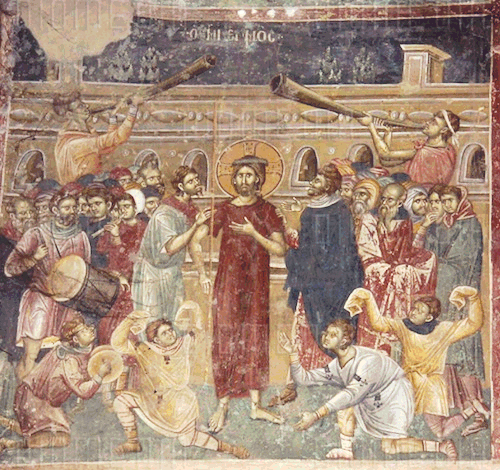
WORSHIP LEADERS LIE ABOUT
EPHESIANS 5
David Young-Shawn Frazier
|
Holy Scripture
|
Prov. 1:23 Turn you
at my reproof:
behold,
I will POUR out my SPIRIT
unto you,
[SO
THAT] I will make known my WORDS unto you. |
John
6:63 It is the SPIRIT
that quickeneth; the flesh profiteth nothing:
the WORDS
that I SPEAK unto
you, THEY ARE SPIRIT, and they are
life. |
The
New Covenant is the Last Will and Testament of Jesus
Christ. All you do is SPEAK it to the HEIRS.
Eph. 5:17 Wherefore
be ye not unwise ,
but understanding what the WILL OF THE LORD
IS
|
Rom.
12:2 And be not conformed to this world: but be ye transformed
by the renewing of your mind, that ye may
prove what is that good, and acceptable, and PERFECT, WILL OF GOD
1Th. 4:3 For this is
the WILL OF GOD even
your sanctification, that ye should abstain from
fornication:
|
There
can be no preacher in the School of Christ: praedĭcātor
, ōris, m. 1. praedico. I.
In gen., one who makes a thing
publicly known, a proclaimer,
publisher, crier
(postclass.), A. One who
publicly commends a thing, a
praiser, eulogist
(class.): “beneficii,”
Cic. Balb. 2, 4:
“te
ipso
praedicatore
ac
teste,”
teste
one
who attests any thing (orally or in writing),
a witness (cf. superstes)
an eye-witness, spectator
NOT A: pĕcūnĭa
Personified: “Pecunia,”
the goddess of gain
1Tim. 6:5
Perverse disputings of men of corrupt minds,
[verified]
and destitute of the
truth, [verified]
supposing that gain is
godliness: from such withdraw thysell [too late]
LIE: The Law of Laying by in store.
https://www.pineycom.com/Honor.God.with.Your.Wealth.David.Young.html
WOE TO SHEPHERDS WHO FEED THEMSELVES.
https://www.pineycom.com/Elders.Are.The.Only.Gratuitous.Teachers.in.A.Church.of.Christ.html
|
Eph.
5:18dmy And Dont
get drunk on alcohol which leads to decadence;
instead
be FILLED
WITH THE SPIRIT |
Eph.
5:18 And be not drunk with wine, wherein is excess;
but be FILLED
WITH THE SPIRIT
Col. 3:16 Let the WORD OF
CHRIST
DWELL in you richly in all wisdom; teaching and
admonishing one anothe
|
dmy
BY
SPEAKING to one
another with psalms, hymns and spiritual songs
|
Eph.
5:19 SPEAKING
to yourselves in psalms and hymns and spiritual
songs,
|
dmy singing
and MAKING MUSIC
|
singing
and MAKING
MELODY [psallo never
meant "Make Music. It means "pluck with your
[harp string, bow string, pubic hair] SILENT
|
dmy
WITH your heart to the Lord
|
IN your heart to the
Lord; [a place]
|
SINGING RATHER THAN SPEAKING
GOD'S WORD IS A UNIVERSAL MARK OF BURNING.
Logos
computation, reckoning
2. statement of a theory, argument,
ouk emeu alla tou l. akousantas prob.
in Heraclit.50; logon ēde noēma amphis alētheiēs discourse
and reflection on reality,
IV. inward debate of the soul, reflection,
deliberation
Regulative and formative forces,
derived from the intelligible and
operative in the sensible universe,
4.speech, delivered in court, assembly
VI. verbal
expression or utterance, lego, lexis
-Lexis
A.speech, OPPOSITE ôidê
-ôidê, 1.art of song 5.
= eppsdê, spell, incantation
4. text of
an author, OPPOSITE exegesis [Peter's
private interpretation outlaws exegesis]
Arist.En1142a26
2. common talk,
report, tradition d. the talk
one occasions, repute, mostly in good sense, good
report, praise, honour,
3. discussion, debate, deliberation,
c. dialogue, as a form of
philosophical debate,
The meaning
of the sunagogue or syllogimos or syllogism
|
THOSE WHO USE "MUSIC"
Jer
11:18 And the Lord hath given me knowledge of it, and I
know it: then thou showedst me their doings.
Jer 11:19 But I
was like a lamb [Eccl.
Lat., of Christ:] or an ox that is brought to the
slaugher;
and I knew not
that they had devised devices against me,
saying, Let us destroy the
tree with the fruit thereof,
and let us cut him off from the land of the living,
that his name may be
no more remembered.
--mansŭesco ,
I.
Act., to tame, to make tame B.
Trop., to render mild, gentle, or peaceable:
gentes mild,
soft, gentle, quiet
“nam me jam ab orationibus dijungo fere,
referoque ad mansuetiores Musas,”
Cic. Fam. 1, 9,
23: “ira,” Ov. Tr. 3, 6,
23.—
Mūsa
, ae, f., = Mousa,
I.a muse, one of the goddesses of
poetry, music,
“Musarum
delubra,”
Cic. Arch. 11, 27:
“hic
Musarum
parens
domusque
Pieria,
Mela,
2, 3, 2: crassiore
Musā,
A. A song, a poem: “musa
procax,”
Hor. C. 2, 1, 37
Dēlūbrum
, i, n. de-luo, the place of expiation, I.a
temple, shrine, sanctuar
Jer. 23:25 I have heard
what the prophets said, that prophesy lies
in my name,
saying, I have
dreamed, I have dreamed.
Jer. 23:26 How long shall this be in the heart of the prophets
that prophesy lies?
yea, they are
prophets of the deceit of their own heart;
Sēductĭo
A A leading or drawing aside: “seductiones
testium,”
B. A misleading, seduction
(eccl. Lat.): “Adam
confessus
est
seductionem,
non
occultavit
seductricem,”
2Th. 2:8 And then shall that Wicked be revealed,
whom the Lord shall
consume with the spirit of his mouth,
and shall destroy
with the brightness of his coming:
2Th. 2:9 Even him, whose coming is after the working of
Satan with all power and signs and lying wonders,
2
Thessalonians 2.10 and with all deception of
wickedness for those who are being lost,
because they didn't receive the love of the truth, that
they might be saved.
2 Thess 2:[11] Because of this, God sends them a working
of error, that they should believe a lie;
ŏpĕrātĭo A
religious performance, service,
or solemnity, a bringing of offerings:
operationes denicales, offerings,
Jer. 23:27 Which think
to cause my people to
forget my name
by their dreams which they tell every man to his
neighbour,
as their fathers
have forgotten my name for Baal.
Prŏphēta
and prŏphētes
, ae, m., = prophētēs,
foreteller, soothsayer, prophet
Sacerdotes
Aegyptiorum,
quos
prophetas
vocant,”
“Aegyptius,
propheta
primarius
Defines the prophesying of Miriam and the Instrumental
Prophesying of the Levites: Parasites.
prīmārĭus
primarius
parasitus,”the
first speaker, he who has a right to be heard,
părăsītus
one who eats with another; hence, a guest (pure
Lat. conviva): parasiti Jovis, [Diotrephes]
Hence, parasitus Phoebi [Apollon, Abaddon],
a player, actor, Mart. 9, 29, 9.—
one who, by flattery and buffoonery, manages to live at
another's expense, a sponger, toad-eater,
parasite (syn. scurra):
Dumb means the inability to MEDITATE on
what is going on.
cōgĭto
The command is to SPEAK the Word and MEDITATE in the heart:
not to make music.
Cogitation in a rational sense can be stopped by (d).
With de: “cogitavit
etiam
de
Homeri
carminibus
abolendis,”
SIMON
THE SORCERER USED BOTH VOCAL AND
INSTRUMENTS
Acts 8:9
And a certain man, by name Simon, was before in
the city using magic [ma^g-euō],
and amazing the nation of Samaria, saying
himself to be a certain great one,
3096. μαγεύω mageuo, mag-yoo´-o; from 3097; to
practice magic: — use sorcery.
3097. μάγος magos, mag´-os; of foreign origin (H7248); a
Magian, i.e. Oriental scientist; by implication, a magician: —
sorcerer, wise man.
Acts 8:10 To whom they all gave heed, from the least to the
greatest, saying, This man is the great power of God.
4337. προσέχω prosecho, pros-ekh´-o; from 4314 and
2192; (figuratively) to hold the mind (3563 implied) towards,
i.e. pay attention to, be cautious about, apply oneself to,
adhere to: — (give) attend(-ance, -ance at, -ance to, unto),
beware, be given to, give (take) heed (to unto); have regard.
Acts 8:10 To whom they all gave heed, from the least to the
greatest, saying, This man is the great power of God.
Acts 8:11 And to him they had regard, because that of long time
he had bewitched them with sorceries.
You can purchase an advanced degree in Spiritual
Formation or performing the roles of Simon Magnus
Măgus
, “artes, carmen,”
Sen. Herc. Oet. 467
carmen
tune, song; poem, verse;
an oracular response, a prophecy; a
form of incantation a tune, song, air,
lay, strain, note, sound, both
vocal and instrumental
“carmine
vocali
clarus
citharāque
[singing with guitar, harp an instrument of
enchantment]
APOLLYON OR ABADDON AS LEADER OF THE MUSES Apollinem
concordant carmina
II.
In the fem., a female magician, enchantress:
cantusque artesque magarum, v. l. Ov. M. 7, 195 (al. leg. magorum):
Circe maga famosissima, Aug. Civ. Dei, 18, 17.
SCRIPTURE AND
HISTORICAL DOCUMENTS: METER OR MELODY INTENDS TO DECEIVE.
https://www.pineycom.com/Laughing-Mocking-Jesus.html
https://www.pineycom.com/BabAkitFest.html
BABYLONIAN AKITU FESTIVAL
- "O my holy jewel! O my wondrous
Inanna!"
- After he enters the holy vulva,
causing the queen to rejoice,
- After he enters the holy vulva,
causing Inanna to rejoice,
- Inanna holds him to her and murmurs:
"O Dumuzi, you are truly my love!"
The musicians
play for the queen,
They play the loud instruments which drowns out the Southern storm,
They play the sweet algar-instruments, the ornament of the palace,
They play the stringed instrument that
brings joy to all people,
They play
songs for Inanna to rejoice the heart.
See the worship of Tammuz and Ishtar
or the SUN in Jerusalem
Pi.N.7.81 Pindar, Nemean Odes 7