Giving is NOT an Act of Worship
Scholars deny that laying by is store is at the church assembly
http://www.pineycom.com/De.Corona.Tertullian.Apology.html#P425_201743
We assemble to read our sacred writings, if any peculiarity of the times makes either forewarning or reminiscence needful.
However it be in that respect, with the sacred words we nourish our faith, we animate our hope, we make our confidence more stedfast; and no less by inculcations of God's precepts we confirm good habits.
In the same place also exhortations are made, rebukes and sacred censures are administered.
For with a great gravity is the work of judging carried on among us, as befits those who feel assured that they are in the sight of God;
and you have the most notable example of judgment to come when any one has sinned so grievously as to require his severance from us in prayer, in the congregation and in all sacred intercourse.
The tried men of our elders preside over us, obtaining that honour not by PURCHASE, but by established character.
There is no buying and selling of any sort in the things of God.
Though we have our treasure-chest, it is not made up of purchase-money, as of a religion that has its price.
- On the MONTHLY day, if he likes, each puts in a small donation;
- but only if it be his pleasure,
- and only if he be able:
- for there is no compulsion;
- all is voluntary.
[On ordinary Sundays, "they laid by in store," apparently: once a month they offered]??
2Cor. 8:8 I speak not by commandment, but by occasion of the forwardness of others, and to prove the sincerity of your love.
2Cor. 9:5 Therefore I thought it necessary to exhort the brethren,
that they would go before unto you,
and make up beforehand your bounty, whereof ye had notice before,
that the same might be ready, as a matter of bounty,
and not as of COVETOUSNESS.
BOUNTY: g2129. εὐλογία eulogia, yoo-log-ee´-ah; from the same as 2127; fine speaking, i.e. elegance of language; commendation (“eulogy”), i.e. (reverentially) adoration; religiously, benediction; by implication, consecration; by extension, benefit or largess: — blessing (a matter of) bounty (x -tifully), fair speech.This is just ONCE to make THE collection just once before Paul arrived and might be an extorting influence. Paul might have to remain in Corinth all winter because of the weather. Each person stored up a part of the First day's work. This money was never in the hands of the Corinthian church.
COVETOUSNESS g4124. πλεονεξία pleonexia, pleh-on-ex-ee´-ah; from 4123; avarice, i.e. (by implication) fraudulency, extortion: — covetous(-ness) practices, greediness.
Even civil society formed local groups and those who prospered gave to those in need. Synagogue were houses for meeting.
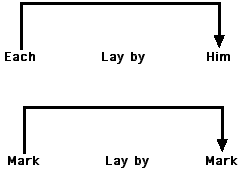
Lay by HIM in store! JOHN LAYS BY JOHN'S PIGGY BANK: 1 Corinthians 16:2 tells the Corinthians to lay by HIM in Store and not lay by at church. Ephesians 4 does not mention a treasurer.
THE DOUBLE CROSS
Jesus Christ authorized no ROLE and no DOLE for even the priest in the curse of the sacrificial system. The Civil-Military-State abandoned back to Babylon received a dail dole of food (only) when he was in rare rotating duty at the Temple (only). Jesus paid it all and Paul said that giving even for the starving was not a commandment. Therefore, those who command that you give your wage which was never tithed so that he can build a Babylonish religious institution is a robber and a parasiite.
Deut. 15:7 If there be among you a poor man of one of thy brethren within any of thy gates in thy land which the LORD thy God giveth thee, thou shalt not harden thine heart, nor shut thine hand from thy poor brother:
Deut. 15:8 But thou shalt open thine hand wide unto him, and shalt surely lend him sufficient for his need, in that which he wantethH5670 abat aw-bat' A primitive root; to pawn; causatively to lend (on security); figuratively to entangle: borrow, break [ranks], fetch [a pledge], lend, X surely.
"Concerning budgets--it is now a mark of the identity of a scriptural church to have or not to have certain benevolent programs and missionary projects in the budget;
but the time was when churches had no such problems, for there were no budgets.
The apportionment of the contributions into a pre-arranged budget is comparatively new,
and it met with opposition for the early writers
of both the Gospel Advocate and the Firm Foundation,
perhaps for the foreseen reason of what is happening now--
an an issue develops on what may or may not be scripturally included in the budget,
and the budget becomes a sacramental thing, the depository for the 'Lord's Money.'"
(Foy E. Wallace, Jr., The Gospel for Today, p 552)Romans 15 defines the ekklesia or synagogue as Paul defines gatherings or assemblies. SELF-pleasure is outlawed and this removes any need for a LAW of giving because it removes and repudiates those institutes of people who insist that you support them.
Rom. 15:1 We then that are strong ought to bear the infirmities of the weak,Those strong enough to assume leadership serve and are not served. Their task is to take care of them as Jesus example. They provide an environment conducive to edification which is edudation in "that which is written." It requires little of the widow's living to do that
and not to please ourselves.
Rom. 15:2 Let every one of us please his neighbour for his good to edification.770. astheneo, as-then-eh´-o; from 772; to be feeble (in any sense): be diseased, impotent folk (man), (be) sick, (be, be made) weak.
772. asthenes, as-then-ace´; from 1 (as a negative particle) and the base of 4599; strengthless (in various applications, literal, figurative and moral): — more feeble, impotent, sick, without strength, weak(-er, -ness, thing) .Outlawing self pleasure outlaws private diversities (Rom 14). Paul's command was to speak "that which was written" and the civil ekklesia did not have the authority to vote on what they thought might be "scriptural." It also outlaws the dogmas of philosophers.
IV IV. areskei is used impers. to express the opinion or resolution of a public body, tauta êrese sphi poieein Hdt.8.19 ; ên d' areskêi taut' Athênaiois Ar.Eq.1311 ; areskei . . einai Delphôn it is resolved that . . , SIG827D10; also of prevailing opinions; ta areskonta the dogmas of philosophers
-Placeo I.part. fut. pass.: “dos placenda,” Plaut. Trin. 5, 2, 35; v. I. A. fin.) [cf. placo], to please, to be pleasing or agreeable, to be welcome, acceptable, to satisfy (class.). 1. In scenic lang., of players or pieces presented, to please, find favor, give satisfaction: “primo actu placeo, Ter. Hec. prol. alt. 31: cui scenico placenti,” Suet. Ner. 42; id. Galb. 12; id. Vit. 11: “populo ut placerent quas fecisset fabulas,” Ter. And. prol. 3; “id. Hec. prol. alt. 12: ubi (fabulae) sunt cognitae, Placitae sunt,”
philosophiae placita, Babyloniorum,” Plin. 2, 79, 81, § 191; Col. 9, 2, 1.
Scaenĭcus I.of or belonging to the stage, scenic, dramatic, theatrical, I.Lit.:poëtae, dramatic poets, Varr. L. L. 9, § 17 Müll.:artifices, players, actors,
Orgănum , i, n., = organon, Of musical instruments, a pipe, Quint. 11, 3, 20; 9, 4, 10; Juv. 6, 3, 80; Vulg. Gen. 4, 21; id. 2 Par. 34, 12Organon , to, ( [ergon, erdô] )Gen. 4:21 And his brother’s name was Jubal: he was the father of all such as handle the harp and organ.
2 Chronicles 34:[12] The men did the work faithfully: and the overseers of them were Jahath and Obadiah, the Levites, of the sons of Merari; and Zechariah and Meshullam, of the sons of the Kohathites, to set it forward; and [others of] the Levites, all who were skillful with instruments of music.A. instrument, implement, tool, for making or doing a thing, for making war, for doing hard work. 3.musical instrument, Simon.31, f.l. in A.Fr.57.1 ; ho mendi' organône kêlei anthrôpous, of Marsyas, Pl.Smp.215c ; aneu organôn psilois logois ibid., cf. Plt.268b ; o. poluchordaId.R.399c , al.; met' ôidês kai tinôno rganôn Phld.Mus.p.98K. ; of the pipe, Melanipp.2, Telest.1.2.
Mŏdŭlātĭo marching to time, thythmical measure, modulation; hence, singing and playing, melody in poetry and music. 2. Placere sibi, to be pleased or satisfied with one's self, to flatter one's self, to pride or plume one's self:
II. Transf.: placet mihi (tibi, etc.), or simply placet, it pleases me, it seems good, right, or proper to me; it is my opinion, I am of opinion, I hold, believe, intend, purpose; and in perf., placuit, or placitum est, it is decided, resolved, determined (mihi, nobis, etc., or absol.).
A. pleasing, mostly in bad sense, obsequious, cringing,
II. areskos, ho, the staff borne by pornoboskoi [brothel keeper] on the stage,
Similar situations can never CHANGE 1 Corinthians 16:2 into a command for a legalistic ACT OF WORSHIP called "lay by him in store" which must be performed or you are cursed. Let's look at that passage again as most scholars have understood it:
Upon the first day of the week let every one of you lay by him in store, as God hath prospered him, that there be no gatherings when I come. 1 Corinthians 16:2
For of a truth it has been said on these matters, let thy almsgiving abide in thy hands until thou knowest to whom thou hast given. Didache 1:6
From a Biblical standpoint, we OWE alms to those who have needs. Therefore, we are commanded to give. However, the RIGHT hand which means "that which takes" must GIVE witout the LEFT HAND knowing. This probably means that our GRASPING hand must be willing to GIVE directly to those in need without filtering through a charitable organization.We are free to give all that we own. However, no one has the authority to demand anything of us as a legalistic act of worship.
"Since the Corinthians know about this collection and ask for further instructions from Paul, the question arises as to when and how they had been told" (Lenski, Commenting on 1 Cor. 16:1, p. 756)
Corinth's voluntary offer to help was used by Paul to motivate other churches. Now, he was worried that they had not saved from their small first-day income and everyone might be embarrassed when the delegation arrived to collect their savings.
But, what about Paul giving orders? The Hebrew word for "order" in 1 Cor. 16:1 is diatasso; it means to arrange thoroughly. For instance, Luke "set forth in order" the things accepted among the believers (Luke 1:1). Rather than a legal command, Luke's letter was an orderly account.
Furthermore, Paul wrote the second letter because his first letter had little effect. Indeed, they might have misunderstood his motives. By keeping the money "by themselves" and by electing someone to help take the total church contribution to Judea, they would be more confident. Therefore, he wrote:
I speak not by commandment, but by occasion of the forwardness of others, and to prove the sincerity of your love. 2 Corinthians 8:8
On the other hand, the Greek for commandment is:
Epitage (g2003) ep-ee-tag-ay'; an injunction or decree; by implication: authority, commandment.
After showing that he was not commanding them to give anything, but was ordering an honest system to do it, Paul continued to say:
Upon the (1) first day of the week let every one of you (2) lay by him in (3) store, as God hath (4) prospered him, that there be no (5) gatherings when I come. 1 Cor. 16:2
Store up is the Greek:
Thesaurizo (g2343) thay-sow-rid'-zo; from 2344; to amass or reserve (lit. or fig.): - lay up (treasure), (keep) in store, (heap) treasure (together, up).
"Storing UP" never means DISPENSING.
This word is not used of the COLLECTION PLATE of an institution:
So is he that layeth up treasure for himself, and is not rich toward God. Lu.12:21
But, after thy hardness and impenitent heart, treasurest up unto thyself wrath against the day of wrath and revelation of the righteous judgment of God; Ro.2:5
Behold, the third time I am ready to come to you; and I will not be burdensome to you: for I seek not yours, but you: for the children ought not to lay up for the parents, but the parents for the children. 2Co.12:14
Your gold and silver is cankered; and the rust of them shall be a witness against you, and shall eat your flesh as it were fire. Ye have heaped treasure together for the last days. Ja.5:3
The Testimony of the Direct Statement of Paul which CANNOT be honestly misunderstood:
"In store" at home is different from the final "collection." Store in Greek is:
KJV: Upon the first day of the week let every one of you lay by him in store, as God hath prospered him, that there be no gatherings when I come. 1 Corinthians 16:2
The KJV makes the location of the savings absolutely certain: it is BY HIM. If you took a lamb to the market and converted it into money, the common method was to STRAP a container to the wrist or arm. Therefore, the money was LAID BY HIM in his thesaurizo or treasure box or bag.
Since PROSPERING means your net increase each week, those with good jobs would have extra cash. Paul tells them that they should SAVE UP part of it for the DESTITUTE. If you want to give it all that is great but Paul does not extort.
Now, flashback
Only one out of three year tithes went to the tribe of Levi who gave the priest 1%. Two of the tithes in the seven year cycle was consumed by the farmer.
The Testimony of Laying By in Store of the Tithe:
Then shalt thou turn it into money, and bind up the money in thine hand, and shalt go unto the place which the Lord thy God shall choose: Deut 14:25
He could, in effect, go live it up because the festivals were more military musters which only involved warrior age males. However, this 2/7 of his giving was for his own consumption.
Charlton T. Lewis, An Elementary Latin Dictionary
Thesaurus or the-nsaurus i-, m, têêsauros, something laid up, a hoard, treasure, provision, store: petit, unde is sit thensaurus sibi, T.: thesaurum defodere . . . invenire: non exercitus neque thensauri praesidia regni sunt, verum amici, S.--A place for safe-keeping, store-house, treasurechamber, treasure-vault, treasury: publicus, L.: Si servata mella Thesauris relines, i. e. the cells of bees, V.--Fig., a repository, conservatory, magazine, collection: thesaurus rerum omnium, memoria: thesauri argumentorum.
Thesaurizo (g2343) thay-sow-rid'-zo; from 2344; to amass or reserve (lit. or fig.): - lay up (treasure), (keep) in store, (heap) treasure (together, up).
This word is specificially used of those who STORE UP BY THEMSELVES. The church does not have a "thesaurus."
So is he that layeth up treasure for himself, and is not rich toward God. Lu.12:21
But, after thy hardness and impenitent heart, treasurest up unto thyself wrath against the day of wrath and revelation of the righteous judgment of God;Ro.2:5
Your gold and silver is cankered; and the rust of them shall be a witness against you, and shall eat your flesh as it were fire. Ye have heaped treasure together for the last days. Ja.5:3
Behold, the third time I am ready to come to you; and I will not be burdensome to you: for I seek not yours, but you: for the children ought not to lay up for the parents, but the parents for the children. 2Co.12:14
Henry George Liddell, Robert Scott, A Greek-English Lexicon
Log-eia , hê, collection of taxes or voluntary contributions, PHib.1.51.2 (iii B. C), PTeb.58.55 (ii B. C.), POxy.239.8 (i A. D.); collection for charity, 1 Ep.Cor.16.1, Hsch.; for religious purposes, GDI4156 (Lindos), PSI2.262.3 (i A. D.); perquisite, PPar.5xxvii 6 (ii B. C.).
It cannot be a VOLUNTARY contributaion and still be part of THE LAW OF GIVING.
The Co-Witness of Other Versions:
NIV: On the first day of every week, each one of you should set aside a sum of money in keeping with his income, saving it up, so that when I come no collections will have to be made. 1 Corinthians 16:2NIV
NAS: On the first day of every week let each one of you put aside and save, as he may prosper, that no collections be made when I come. 1 Corinthians 16:2NAS
NKJV: On the first day of the week let each one of you lay something aside, storing up as he may prosper, that there be no collections when I come. 1 Corinthians16:2
This says: You put aside, You Save
RSV: On the first day of every week, each of you is to put something aside and store it up, as he may prosper, so that contributions need not be made when I come. 1 Corinthians 16:2
LIV: On every Lord's Day each of you should put aside something from what you have earned during the week, and use it for this offering. The amount depends on how much the Lord has helped you earn. Don't wait until I get there and then try to collect it all at once. 1 Corinthians 16:2
Modern Speech: On the first day of every week let each of you put on one side and store up at his home whatever gain has been granted him; so that whenever I come, there may be no collections going on. (The Modern Speech New Testament, Richard Francis Weymouth).
Authentic Version: The day after the Sabbath let each of you put by savings as he has prospered, so that collections do not have to be made when I come. (The Authentic Version, Hugh J. Schonfield).
NEV: Every Sunday each of you is to put aside and keep by him a sum in proportion to his gains, so that there may be no collecting when I come. (New English Bible New Testament).
Plain English: On the first day of the week let each of you put aside and save something from his earnings; so that the money has not all to be collected when I come. (The New Testament in Plain English, Charles Kingsley Williams).
Neander: But Paul, if we examine his language closely, says no more than this: that every one should lay by in his own house on the first day of the week, whatever he was able to save.
This certainly might mean, that every one should bring with him the sum he had saved to the meeting of the church, that thus the individual contributions might be collected together, and be ready for Paul as soon as he came. But this would be making a gratuitous supposition, not at all required by the connexion of the passage.
We may fairly understand the whole passage to mean, that every one on the first day of the week should lay aside what he could spare, so that when Paul came, every one might be prepared with the total of the sum laid by, and then by pulling the sums together, the collection of the whole church would be at once made." Dr. Augustus Neander, in his "History of the Training and Planting of the Christian Church,"
The FIRST DAY OF THE WEEK was the FIRST DAY OF WORK for most. Out of his FIRST PAY DAY he should store up a sum.
Paul did not hint that they lay by in store on the SECOND DAY of the week. Thus, what he gave was from his first pay check. 10% of his whole weeks pay would be outrageous extortion.
Collecting money almost always meant converting animals or produce to money, or collecting small amount of money week by week. Therefore, they could not wait until the last moment.
Therefore I thought it necessary to exhort the brethren, that they would go before unto you, and make up beforehand your bounty (blessings), whereof ye had notice before, that the same might be ready, as a matter of bounty (blessing), and not as of covetousness (extortion). 1 Cor 9:5
The Witness of the Didache possibly 2nd century
Didache 1:5 Give to every one that asketh of thee, and ask not again;
........... for the Father wishes that from his own gifts there should be given to all.
........... Blessed is he who giveth according to the commandment, for he is free from guilt;
........... ........... but woe unto him that receiveth.
........... For if a man receive being in need, he shall be free from guilt;but he who receiveth when not in need, shall pay a penalty as to why he received and for what purpose; and when he is in tribulation he shall be examined concerning the things that he has done, and shall not depart thence until he has paid the last farthing.
Didache 1:6 For of a truth it has been said on these matters, let thy almsgiving abide in thy hands until thou knowest to whom thou hast given.
Now, surely this verse is not the basis for writing a new creed with a new "act of worship." Well, we should move carefully through Paul's letters because Peter warned that they could be dangerous stuff if we don't really study out of a love for the truth. (2 Peter 3:16).
Because the Greeks did not observe a seven-day week with one day for "rest" and one for "church," we need to understand the meaning of "first day of the week."
Ecclesiasticus as part of the Apocrypha in the Septuagint which Jesus quotes and in the first King James Version notes:
Give to the godly man, but do not help the sinner. Ecclu 12:4.
Do good to the humble, but do not give to the ungodly; hold back his bread, and do not give it to him, lest by means of it he subdue you; for you will receive twice as much evil for all the good which you do to him. Ecclu 12: 5.
........... For the Most High also hates sinners and
........... will inflict punishment on the ungodly. Ecclu 12: 6.Give to the good man, but do not help the sinner. Ecclu 12: 7.
Justin Martyr spoke for all early churches which did not treat giving as an ACT of worship:
And we afterwards continually remind each other of these things.
And the wealthy among us help the needy;
and we always keep together; and for all things wherewith we are supplied
And they who are well to do, and willing, give what each thinks fit;and what is collected is deposited with the president, who succours the orphans and widows and those who, through sickness or any other cause, are in want, and those who are in bonds and the strangers sojourning among us, and in a word takes care of all who are in need.
Free will and a commanded act of worship don't go together.
Tertullian, Apology, b. c. 155, /160, Carthage [now in Tunisia] d. after 220, Carthage
In like manner, by public law you disgrace your state gods,
putting them in the auction-catalogue, and making them a source of revenue.Men seek to get the Capitol, as they seek to get the herb market, under the voice of the crier, under the auction spear, under the registration of the quµstor.
Deity is struck off and farmed out to the highest bidder. But indeed lands burdened with tribute are of less value;
........... men under the assessment of a poll-tax are less noble;
........... for these things are the marks of servitude.In the case of the gods, on the other hand, the sacredness is great in proportion to the tribute which they yield; nay,the more sacred is a god, the larger is the tax he pays. Majesty is made a source of gain.
Chapter XXXIX notes that while men may have LAID BY THEM IN STORE it was not deposited AT CHURCH on a weekly basis as "an act of worship."
The tried men of our elders preside over us, obtaining that honour not by purchase, but by established character.
There is no buying and selling of any sort in the things of God.
Though we have our treasure-chest, it is not made up of purchase-money,
........... as of a religion that has its price.
........... On the monthly day, if he likes, each puts in a small donation;but only if it be his pleasure,
and only if he be able:
for there is no compulsion;
all is voluntary.[Note in text: On ordinary Sundays, "they laid by in store," apparently: once a month they offered]
These gifts are, as it were, piety's deposit fund.
For they are not taken thence and spent on feasts, and drinking-bouts, and eating-houses,
> but to support and bury poor people,
> to supply the wants of boys and girls destitute of means and parents,
> and of old persons confined now to the house;
> such, too, as have suffered shipwreck;
> and if there happen to be any in the mines, or banished to the islands, or shut up in the prisons,
- > > for nothing but their fidelity to the cause of God's Church,
- they become the nurslings of their confession.
Lenski notes that in state religions such as that of Egypt, "the taxes were paid from month to month while the Christians were to retain their gifts at home until such a time as they should be called for." Of "laying by him in store," the International Standard Bible Encyclopedia notes that:
"Worship is here not explicitly mentioned. The Greek of 'by him' is the usual phrase for 'at home'."
Paul did not make a law but defined a method or order for all participating churches to get ready:
> "Sunday by Sunday let each of you lay by by treasuring up... Each member is to keep the growing amount 'by him,' in his own home, and is not to deposit it with the church at once." (Lenski, p. 1 Corinthians 16:2)
"Lay" is from the Greek Tithemi and means "put, arrange, commit or purpose in the heart."
Example One: In Acts 4:35 they "Laid money at the apostles feet."
Example Two: In 1 Corinthians 16:2 they "laid money by him."
Conclusions: Therefore, the command was to lay it by themselves:
> "Every one was to lay by in store, have a treasury, or fund, WITH HIMSELF, for this purpose. The meaning is that he should lay by as he could spare from time to time, and by this means make up a sum for this charitable purpose. The Greek fathers rightly observe that this advice was given for the sake of the poorer among them.
They were to lay by from week to week,
and NOT bring into the COMMON TREASURY,that by this means their contributions might be easy for themselves, and yet grow into a fund for the relief of their brethren." (Theological Dict. of the N.T., p. 599).
> Augustine speaking of those who tithed even twigs of spices notes that one TITHES or lays by in store. Out of that "cup" or storage place he is then able to give ALMS. That is, they LAID BY HIM IN STORE or bound it to their hand. When he saw a brother or sister in need he had the "bounty" already made up.
3. When He had spoken thus, doubtless they thought that they did give alms. And how did they give them?
They tithed all they had, they took away a tenth of all their produce, and gave it. It is no t easy matter to find a Christian who doth as much.
See what the Jews did. Not wheat only, but wine, and oil; nor this only, but even the most trifling things, cummin, rue, mint, and anise, in obdience to God's precept,
they tithed all;
put aside, that is, a tenth part,
and gave alms of it.In 4 out of 7 'tithes' the tither bound it to their hand or stored up in their own area where it was available to be dispensed by the Levites to the needy--when the need arose. They did not have a DREAM TEAM calculating how to lay more burdens on the flock used as pack animals.
> John Chrysostom Homily XLIII. He SAID NOT, "Let him bring it the church," lest they might feel ashamed because of the smallness of the sum;
but "having by gradual additions swelled his contribution, let him then produce it, when I am come but for the present lay it up," saith he, "at home, and make thine house a church; thy little box a treasury. Become a guardian sacred wealth, a self-ordained steward of the poor. Thy benevolent mind assigns to thee this priesthood."
> Vincent Word Studies In The New Testament
2. Upon the first day of the week (kata mian sabbatou). Kata has a distributive force, every first day. For week, lit., Sabbath, see on Acts xx. 7.
Lay by him in store (par eautw tiqetw qhsaurizwn). Lit., put by himself treasuring. Put by at home. As God hath prospered (o ti an euodwtai). Lit., whatsoever he may prosper in. See on Rom. i. 10; 3 John 2; and on Acts xi. 29 for the verb eujporew in the similar sense of making a prosperous journey.
No gatherings, etc. Rev., collections. The amount would be greater through systematic weekly saving than through collections made once for all on his arrival.
Verse 1. The collection for the saints] peri-thv logiav, from legw, to gather, or collect; translated by the Vulgate, de collectis, a contribution made by the rich for the relief of the poor. The Christians living at Jerusalem, we may naturally suppose, were greatly straitened; as the enmity of their countrymen to the Gospel of Christ led them to treat those who professed it with cruelty, and spoil them of their goods; (see Heb. x. 34; and Romans xv. 26; and see the note Rom. xv. 27;) and the apostle hereby teaches that it was the duty of one Christian congregation to help another when in distress.
We doubt that the churches had a "poor box" but if they did, the rules of the synagogue still directs the gifts to the poor:
7. We may observe that the apostle follows here the rule of the synagogue; it was a regular custom among the Jews to make their collections for the poor on the Sabbath day, that they might not be without the necessaries of life, and might not be prevented from coming to the synagogue. 8. For the purpose of making this provision, they had a purse, which was called hqdx l? yqnra Arneki shel tsedakah, "The purse of the alms," or what we would term, the poor's box. This is what the apostle seems to mean when he says, Let him lay by him in store-let him put it in the alms' purse, or in the poor's box
> Albert Barnes
"Let him lay up at home, treasuring up as he has been prospered. The Greek phrase, "by himself," means, probably, the same as at home. Let him set it apart; let him designate a certain portion, let him do this by himself, when he is at home, when he can calmly look at the evidence of his prosperity.
Let him do it not under the influence of pathetic appeals,
........... or for the sake of display when he is with others;
........... but let him do it as a matter of principle, and when he is by himself.The phrase in Greek, "treasuring up" may mean that each one was to put the part which he had designated in the common treasury. This interpretation seems to be demanded by the latter part of the verse. They were to lay it by, and to put it into the common treasury, that there might be no trouble of collecting when he should come. Or it may, perhaps mean that they were individually to treasure it up, having designated in their own mind the sum which they could give, and have it in readiness when he should come. This was evidently to be done not on one Sabbath only, but was to be done on each Lord's day until he should come."
> R.C.H. Lenski
"Each member is to deposit with himself each Sunday the amount of his gift for that week and preserve it as a store or treasure...
Each member is keep the growing amount 'by him'..., in his own home,
and is not to deposit it with the church at once.The probable reason for this advice is the fact that at this early date the churches supervised by Paul were not yet organized to the extent of having official treasurers who were duly appointed to take charge of congregational funds....
Paul's purpose in ordering contributions from Sunday to Sunday is that, when he finally arrives in Corinth, the work may be entirely done. The plural logiai, "collections'' refers to the accumulations made by the individuals; each would have his logia made....
The collections are not to proceed after Paul arrives. Then it will be necessary that each individual simply bring in his accumulation."
Paul said that he didn't want any collections after he arrived because that would smack of extortion.
Paul said "I might remain with you all winter."
Therefore, this giving does not authorize an ongoing collection as an act of worship. The ekklesia was always ready to look out for the poor. But, they DID NOT collect money and then form a committee to decide how to spend it.
1. The manner in which the collection was to be made: Every one was to lay by in store (v. 2), have a treasury, or fund, with himself, for this purpose.
The meaning is that he should lay by as he could spare from time to time, and by this means make up a sum for this charitable purpose.
Note, It is a good thing to lay up in store for good uses. Those who are rich in this world should be rich in good works, 1 Tim. 6:17, 18. The best way to be so is to appropriate of their income,
........... and have a treasury for this purpose, a stock for the poor as well as for themselves.By this means they will be ready to every good work as the opportunity offers; and many who labour with their own hands for a livelihood should so work that they may have to give to him that needeth, Eph. 4:28.
Indeed their treasury for good works can never be very large (though, according to circumstances, it may considerably vary); but the best way in the world for them to get a treasury for this purpose is to lay by from time to time, as they can afford.
Some of the Greek fathers rightly observe here that this advice was given for the sake of the poorer among them. They were to lay by from week to week, and not bring in to the common treasury, that by this means their contributions might be easy to themselves, and yet grow into a fund for the relief of their brethren. "
1 Corinthians 16:2 {Upon the first day of the week} (kata mian sabbatou). For the singular sabbatou (sabbath) for week see #Lu 18:12; Mr 16:9. For the use of the cardinal mian in sense of ordinal prwten after Hebrew fashion in LXX (Robertson, _Grammar_, p. 672) as in #Mr 16:2; Lu 24:1; Ac 20:7. Distributive use of kata also.
{Lay by him in store} (par' heautwi tiqetw qesaurizwn).By himself, in his home.
Treasuring it (cf. #Mt 6:19f. for qesaurizw).Have the habit of doing it, tiqetw (present imperative). {As he may prosper} (hoti ean euodwtai). Old verb from eu, well, and hodos, way or journey, to have a good journey, to prosper in general, common in LXX. In N.T. only here and #Ro 1:10; 3Jo 1:2. It is uncertain what form euodwtai is, present passive subjunctive, perfect passive indicative, or even perfect passive subjunctive (Moulton, _Prolegomena_, p. 54). The old MSS. had no accents. Some MSS. even have euodwqei (first aorist passive subjunctive). But the sense is not altered. hoti is accusative of general reference and ean can occur either with the subjunctive or indicative. this rule for giving occurs also in #2Co 8:12. Paul wishes the collections to be made before he comes.
In Store
"The expression 'in store' is sometimes used to support the 'storehouse' found in Malachi. The phrase 'in store' actually means to save up in a kind of 'piggy bank.' The Greek words par heauto mean 'by oneself' or 'at home.' The idea behind Paul's remark is that they should accumulate their gifts (which could include money and other goods, like raisins), so that when his company arrived Paul would not have to make any special effort to consummate the collection. (Searching Together Magazine, Winter, 1987)
Paul might spend the winter--up to three months--in Corinth, but he still insisted that he wanted no collections during this time to avoid the feeling of extortion.
And when they were come into the house, they saw the young child with Mary his mother, and fell down, and worshipped him: and when they had opened their treasures, they presented unto him gifts; gold, and frankincense, and myrrh. Matthew 2:11
Jesus spoke of the COMMON TREASURY "collection plate" which was the:
Gazophulakion (g1049) gad-zof-oo-lak'-ee-on; from 1047 and 5438; a treasure-house, i.e. a court in the temple for the collection-boxes: - treasury
And he said unto them in his doctrine, Beware of the scribes, which love to go in long clothing, and love salutations in the market places, Mark 12:38
And the chief seats in the synagogues, and the uppermost rooms at feasts: Mark 12:39
Which devour widows houses, and for a pretense make long prayers: these shall receive greater damnation. Mark 12:40
One such "Scribe" was asked by a widow who lived on wellfare and foodstamps: "Do I have to tithe?" "Yes, that is the law." This is the prime example of those who could read and write "taking the food off the widow's table" as Christian.
Christ had such an example:
And Jesus sat over against the treasury, and beheld how the people cast money into the treasury: and many that were rich cast in much. Mark 12:41
And there came a certain poor widow, and she threw in two mites, which make a farthing. Mark 12:42
And he called unto him his disciples, and saith unto them, Verily I say unto you, That this poor widow hath cast more in, than all they which have cast into the treasury: Mark 12:43
For all they did cast in of their abundance; but she of her want did cast in all that she had, even all her living. Mark 12:44
The widow had Christ's approval but the facts seem to say: "Woe to those who accept the widow's mite."
AND as he went out of the temple, one of his disciples saith unto him, Master, see what manner of stones and what buildings are here Mark 13:1
And Jesus answering said unto him, Seest thou these great buildings? there shall not be left one stone upon another, that shall not be thrown down. Mark 13:2
Paul would command and demonstrate that the "scribes" should work with their own hands so that they would have something to give to the widow who had no insurance or "retirement plan." If the "father" forces the children to support him he is worse than an infidel.
Nothing can be considered necessary for Christ to build His church which demands other than support to the evangelist. While we might logical decide to do many things, any demand that GIVING is an ACT OF WORSHIP which must be performed weekly invalidates the totality of our witness because the Water of the Word is free (Isaiah 55).
Alexander Campbell is very explicit in denouncing for either sex what is implied in selecting deaconesses in the mega churches or mega-towers of Babel like "temple states" which go beyond the prescription for the deacons:
It was not so much per annum to the BISHOP, nor so much per annum to the poor, nor so much per annum to the Lord's table; but according to the exigencies of each and the ability to contribute, was the extent of the treasury and the distribution of the stewards or deacons of the congregation.
The plain and simple state of the case is this: Christian congregations in primitive times, had need of money or earthly things as well as we. They had rich and poor members. Their poor were such as could not, either through bodily infirmities, or through the inadequate proceeds of their labor in times of embarrassment, furnish their own tables. Those who had to spare were then called upon to supply their wants. And in many instances they not only contributed to the wants of their own poor, but to the wants of those of remote christian communities, in times of general scarcity or pecuniary difficulties.
The indolent, slothful, and bad economists are censured, admonished, and reformed, or excluded. The Lord's table is constantly furnished. The bishops' wants and necessities always supplied, and no one deprived of any necessary good. There are persons fitted for every service; and those who attend continually on this good service, become eminent in the faith, and after refreshing others are again in turn refreshed themselves.
The contracting of heavy and oppressive debts is proscribed.
No brother is allowed to enthral himself or others in any sort of worldly speculations which incur either anxiety on his part or inconvenience to others. The aged, feeble, and helpless are taken care of by the brethren.
In this view of the deacon's office, we cannot but concur with the sayings and views of the primitive fathers who considered the deacons as the treasurers of the congregation, and as appointed to the service of tables, viz. the Lord's table, the poor's table, and the bishop's table.
Campbell's exegesis is for the most part not explicit in this essay, and some of his interpretations may be questioned, but it is clear that he believed the churches in the New Testament had female deacons who, like the male deacons, administered church finances in attending to the needs of the poor.
Giving is NOT an ACT OF WORSHIP in the normal meaning of apostate Christianity. There is nothing which can be ACCUMULATED from Scripture about the need to give which can make 1 Corinthians 16:2 into a direct command for taking up weekly collections.
When you make Christianity into a law, the resources dry up: when people plan together there is never a shortage of free will giving.
Kenneth Sublett