John.T.Willis.Amos.5.and.INSTRUMENTAL.MUSIC.WORSHIP

Acts.17.25.God.Not.Worshipped.Mens.Hands.html

Therefore, you worship the BEAST if you pay for Rhetoric, Singing, Playing an instrument, hearing opinion, hear experiences or PAY TO PLAY.  The Babylon Mother of Harlots uses lusted after clergy as singers, instrument players, any religious craftsperson clearly defined as a PARASITE. The first BEAST depended on lying about and slandering the Biblical Regulative Principle.  When so few congregations could be seduced, music and the effeminate was called to the trenches;

REASONABLE OR RATIONAL WORSHIP IS A SCHOOL OF THE WORD OR SPIRIT; Your Church is not Christian because it does not CONTINUE IN HIS WORD.

Jesus said that He and His Disciples were FROM ABOVE: The Jewish Clergy were from BENEATH or Tartarus.
Terra or dust " tera natives of the soil, aborigines, autochthones" The Earth as goddess used by feminists:  Personified, Terra, the Earth, as a goddess; “usu. called Tellus, Magna Mater, Ceres, Cybele, etc
T
he infernal regions, Prop. 3, 5

Jeanene.P.Reese.Theology.of.Women.Teachers
Jeanene.Reese.LGBT.MUST.be.Included.html


The BEAST from the EARTH
exerciseth all the POWER of the first BEAST before him,
        and causeth the earth and them which dwell therein
        to worship the first BEAST, whose deadly wound was healed.
Rev. 13:12
1Cor. 15:45 And so it is written,
        The first man Adam was made a living soul;
        the last Adam was made a QUICKENING SPIRIT
        but that which is natural;
        and afterward that which is spiritual.
1Cor. 15:47 The first man is OF the EARTH, earthy:
        the second man is the Lord from heaven.

1Cor. 15:50 Now this I say, brethren,
        that flesh and blood cannot inherit the kingdom of God;
        neither doth corruption inherit incorruption.


POWER of the BEAST: exous-ia Power to win praise.

Strab. 1.2.17
If any thing does not correspond, [To Customs or Laws]
        it should be attributed to change,
        or to misconception,
        or to poetical licence,
               which is made up of [a] history, [b] rhetoric, and  [c] fiction.
                       and Truth is the aim of the historical portion,..

A lively interest is the end ,
        [b]
the rhetorical as when he points to us the combat;
        [c]  and of the fiction, pleasure and astonishment...
HE bids us not to judge poems by the standard of intellect,
         nor yet look to them for history.
Poi-ētikos  p. kai mousikoi  the art of poetry mousi^kos , ē, on, Dor. mōsikos , ta mousika music, II. of persons, skilled in music, musical, X.l.c., etc.; “poiētikoi. andresPl.Lg.802b; “kuknos kai alla zōa m.Id.R.620a; “peri aulous -ōtatoiAth.4.176e; LYRIC poet, OPPOSITE. EPIC, Pl.Phdr.243a   mousikos kai melōn poētēs
mole  melōn There is no music or lyric material in Scripture.
B.
esp. musical member, phrase: hence, song, strain,
en melei poieein to write in lyric strain
2. music to which a song is set, tune, Arist.Po.1450a14

kat-auleô   A. charm by flute-playing, tinos Pl.Lg.790e, cf. R.411a; tina Alciphr.2.1: metaph., se . . -êsô phobôi I will flute to you on a ghastly flute, E.HF871 (troch.):--Pass., of persons, methuôn kai katauloumenos drinking wine to the strains of the flute, Pl.R.561c; k. pros chelônidos psophon to be played to on the flute with lyre accompaniment, Posidon.10 J., cf. Call.Fr.10.3 P., Phld.Mus.p.49 K.
God is not ignorant, as Theologians claim. If He had intended musical melody He would not have used PSALLO
CONTRARY AND ANTITHETICAL to the worship of God, THE WORSHIP OF THE BEAST is--

Thera^p-euō   II.   do service to the gods, athanatous, theous th., Hes.Op.135, Hdt.2.37, X.Mem.1.4.13, etc.; daimonaPi.P.3.109; Dionuson, Mousas, E.Ba.82 (lyr.), IT1105(lyr.); th. Phoibou [
Apollon”] naous serve them, Id.Ion111 (anap.): abs., worship, Lys.6.51; do service or honour to one's parents, E.Ion183 (lyr.), Pl.R.467a, Men.91a; serve, wait upon a master, Id.Euthphr.13d, cf. Ar.Eq.59, 1261, etc.; th. tas thēkas reverence men's graves, Pl.R.469a.
APOLLYON- Phoebus , i, m., = Phoibos (the radiant), I. a poetical appellation of Apollon as the god of light: “quae mihi Phoebus Apollon, Val. Fl. 1, 228: “Circe,” [CHURCH AS WORSHIP CENTER] daughter of Sol, Petr. 135.—
John.York.Lipscomb.University.Austin.Graduate.School.of.Theology.htmlAbilene Christian University 1988 Instrumental Idolatry

http://www.pineycom.com/Amos-Five.html

THE JOHN T WILLIS GREAT RED DRAGON NOTES.

ANYONE WHO CLAIMS THAT GOD PROVIDED ANY MUSICAL WORSHIP INCLUDING INSTRUMENTS, NOTES PAUL IN EPHESIANS 4 IS LYING IN WAIT TO DECEIVE. NOW IS THE RIGHT TIME.


CLICK BELOW FOR NOTES ON AMOS 5 AS PATTERN FOR YOUR WORSHIP

John T. Lewis defends Amos and the music-in-worship pattern for the Christian Assembly. He and about everyone unwittingly approves the Levites "make the lambs and infants dumb before the slaughter by being burned" IF they practice social justice.

In a lecture at ACU in 1988 John T. Willis uses the word WORSHIP 32 times in connection with musical instruments.


All Hebrew, Greek or Latin words for worship demanded a reverent bowing with face toward the ground. Most often people worshipped by FALLING ON THEIR FACE in reverence and godly fear.

In connection with the not-commanded Civil-Military-Clergy complex abandoned to worship the starry host, the Jacob-cursed and god-abandoned Levites stood in ranks with instrument and sword.  When they made a SOUND it was not worship but a warning that those present must bow or fall on their face or get hurt.

One out of Seven days for rest from work was to protect the people against exploiters: it protected workers from land owners and it protected the godly Jews from the Babylonian-inherited Seventh Day and Tithe.  The Sabbath-Day Journey quarantined everyone to the very isolated settlements. 

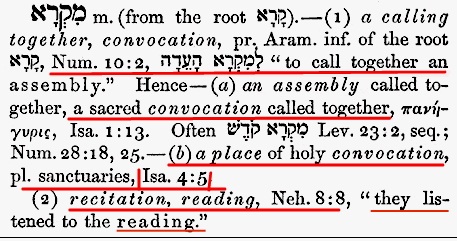
Sabbath never meant a day of WORSHIP.  When the tribal representatives and warriors held festivals, often a HOLY CONVOCATION was held on the First and Eighth days. In time, the Church of the Rock could assemble each SABBATH day when they were free from work and had a vocational elder to READ the Word.  Most people could LEARN IN SILENCE without interrupting the pattern of SPEAK or READ.

The one-piece PATTERN for the non Civil-Military-Clergy
The OFT-Repeated PATTERN
h4744.Miqra.gif Acts 15:21 For Moses of old time hath in every city them that preach him, being read in the synagogues every sabbath day.

Acts 13:27 For they that dwell at Jerusalem, and their RULERS,  because  they knew him not, nor yet the VOICES  of the PROPHETS which are READ every sabbath day, they have fulfilled them in condemning him

Eph. 2:19 Now therefore ye are no more strangers and foreigners, but fellowcitizens with the saints, and of the household of God;
Eph. 2:20 And are BUILT UPON  the foundation of the apostles and prophets, Jesus Christ himself being the chief corner stone;
Col. 2:7 Rooted and built up in him, and stablished in the faith, as ye HAVE BEEN TAUGHT, abounding therein with thanksgiving.

Is. 23:15 And it shall come to pass in that day,
        that Tyre shall be forgotten seventy years, according to the days of one king:
        after the end of seventy years shall Tyre sing as an harlot.

WHAT IS THE SONG OF THE HARLOT?

meretrix  D. In gen., she that is first, a leader, directress, mistress (mostly poet.): “silvestris regina chori,” i. e. the leader, She who earns moncy; hence, a prostitute, harlot, courtesan: “ita sunt hic meretrices omnes elecebrae argentariae,

chŏrus , i, m., = khoros [cf. Lidd. and Scott under khoros].  a troop or band of dancers and singers, a chorus, choir: “saltatores, citharistas,
cŭpĭdĭtas;'    'lĭbīdo        
        '
cŭpĭdĭtas  Agitators: b. Carnal desire, lust, Plin. 36, 5, 4, § 21; “of animals,Col. 6, 27, 4.—

Is. 23:16 Take an [1] harp,
        go about the city, thou harlot that hast been forgotten;
        make sweet
[2] melody,
        sing many
[2] songs, that thou mayest be remembered.

The singers and instrument players and THEIR talent ALWAYS wants to be remembered

The One-Piece Pattern for the assembly is that the WORDS of Christ be REMEMBERED for our learning.  If the wife didn't catch on, she should ask her husband at home

1Cor. 11:25 After the same manner also he took the cup, when he had supped,
        saying, This cup is the new testament in my blood:
        this do ye, as oft as ye drink it, in REMEMBRANCE OF ME

PAUL WANTS MALE AND FEMALE TO BE SILENCE BEYOND LEARNING THE TRUTH OR THE WORD.

1Tim. 2:4 Who will have all men to be saved,
        and to come unto the knowledge of THE TRUTH.

JESUS IS THE ONLY TEACHER OF THOSE HE HAS ADDED TO HIS SCHOOL BY REQUEST AT BAPTISM.

1Tim. 2:5 For there is ONE GOD,
         and one mediator between God and men,
         the man Christ Jesus;

The Lord's Supper again proves to those with eyes and ears the singular PATTERN for Disciples who are Students of Christ and do not DO human performances to prove to GOD that we know better.

1Tim. 2:6 Who gave HIMSELF a ransom for all,
        to be TESTIFIED in due time.
1Pet. 1:11 Searching what, or what manner of time
        the SPIRIT of Christ  [defining the assembly both Inclusively and Exclusively]
        which was in them did signify,
        when it
TESTIFIED beforehand the sufferings of Christ, and the glory that should follow.
Rev. 19:10 And I FELL AT HIS FEED TO WORSHIP HIM..
        And he said unto me, See thou do it not: I am thy fellowservant,
        and of thy brethren that have the TESTIMONY of Jesus:
        worship God:
        for the
TESTIMONY of Jesus is the SPIRIT of prophecy.

Rev. 12:11 And they overcame him by the BLOOD of the Lamb,
        and by the WORD of their
TESTIMONY;
        and they loved not their lives unto the death.
Rev. 12:17 And the dragon was wroth with the woman,
        and went to make war with the remnant of her seed,
        which keep the commandments of God,
         and have the
TESTIMONY of Jesus Christ.
The separation of the GODLY CIVILIANS from the Civil-Military-Clergy is understood by any Bible Student happened when Aaron permitted the people to revert to the Egyptian (Apollo-Apollyon) Instrumental-Trinitarian-Perverted "play" to break out. The connection between religious "worship" and sexual or homosexual outbreak.

Carol Wimber and the Fuller Pattern

This is an appropriate response to God if the church is on that crest.
It is inappropriate if it is whipped up or if the focal point is on the dance rather than on true jubilation in the Lord.

Expression then moves to a zenith, a climatic point, not unlike physical lovemaking (doesn't Solomon use the same analogy in the Song of Songs?). We have expressed what is in our hearts and minds and bodies,

and now it is time to wait for God to respond. Stop talking and wait for him to speak, to move. I call this, the fourth phase, visitation: The almighty God visits his people.

"And Euripides does likewise, in his Bacchae, citing the Lydian usages at the same time with those of Phrygia, because of their similarity:

But ye who left Mt. Tmolus (Sardis was on this mt.), fortress of Lydia, revel-band of mine, women whom I brought from the land of barbarians as my assistants and travelling companions,

There are, it may be, so many kinds of voices in the world, and none of them is without signification. 1 Corinthians 14:10

Therefore if I know not the meaning of the voice, I shall be unto him that speaketh a barbarian, and he that speaketh shall be a barbarian unto me. 1 Corinthians 14:11

uplift the tambourines native to Phrygian cities, inventions of mine and mother Rhea.

And again, happy he who, blest man, initiated in the mystic rites, is pure in his life, . . . who, preserving the righteous orgies of the great mother Cybele, and brandishing the thyrsus on high, and wreathed with ivy, doth worship Dionysus.

Come, ye Bacchae, come, ye Bacchae, bringing down (double entendre) Bromius, (boisterous one) god the child of god, out of the Phrygian mountains into the broad highways of Greece.

"Come Holy Spirit, come, make us truly new creatures in Christ"

Who changed the truth of God into a lie,
        and worshipped and served the
creature more than the Creator, who is blessed for ever. Amen. Rom 1:25

For this cause God gave them up unto vile affections:
        for even their women did change the natural use into that which is against nature: Rom 1:26

And likewise also the men, leaving the natural use of the woman,
        burned in their lust one toward another; men with men working that which is unseemly, and receiving in themselves that recompence of their error which was meet. Rom 1:27


History proves that MELODY as TUNEFUL "belongs to the 19th century." A one-note melody was back-up even to speaking in the style of cantillation
Cantillation: the manner of chanting ritual readings from the Hebrew Bible in synagogue services. The chants are written and notated in accordance with the special signs or marks printed in the Masoretic Text of the Bible, to complement the letters and vowel points.
 
In connection with the not-commanded Civil-Military-Clergy complex abandoned to worship the starry host, the Jacob-cursed and god-abandoned Levites stood in ranks with instrument and sword.  When they made a SOUND it was not worship but a warning that those present must bow or fall on their face or get hurt.

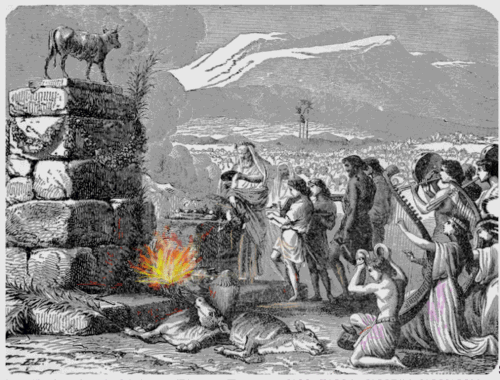
 Exodus.32.Worship.of.Golden.Calf

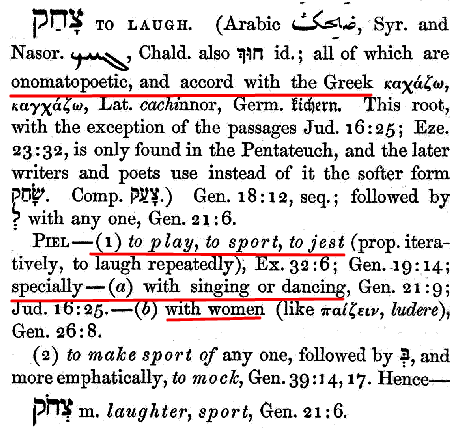
Exod 32:6 And they rose up early on the morrow,  and offered burnt offerings, and brought peace offerings; 
        and the people sat down to eat and to drink, and rose up to pla
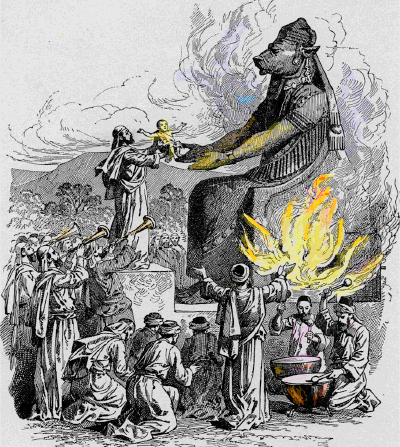
Moloch.harp.drum.flute.gifh6711.tsachaq.gif
euphrainō  II. Pass., make merry, enjoy oneself, “euphrainesthai hekēlon” 

Pind. I. 1 My mother, Thebe of the golden shield, I shall place your interests above my lack of leisure. 
   
agōnio   without angle  2. agōniō skhola” (Corner silent for LEARNING only)
    askhol-ia  OPPOSITE  hēsukhia, required to LEAR IN SILENCE: a female probllem

euphrainō 
Pl.Lg.796b ,Nor should we omit such mimic dances as are fitting for use by our choirs,—for instance, the sword-dance of the Curetes here in Crete, and that of the Dioscori in Lacedaemon; and at Athens, too, our Virgin-Lady gladdened by the pastime of the dance deemed it not seemly to SPORT with empty hands

SPORT. Rise up to PLAY paizō
5. play amorously, “pros allēlousX.Smp.9.2
4. play on a musical instrument, h.Ap.206: c. acc., “Pan ho kalamophthogga paizōnAr.Ra.230; dance and sing, Pi. O.1.16.
      Xen. Sym. 9.2  After he had withdrawn, a chair of state, first of all, was set down in the room, and then the Syracusan came in with the announcement: “Gentlemen, Ariadne will now enter the chamber set apart for her and Dionysus; after that, Dionysus, a little flushed with wine drunk at a banquet of the gods, will come to join her; and then they will disport themselves together.”


See 2 Peter 2 for Peter's warning
2 Peter 2:13 And shall receive the reward of unrighteousness,\
        as they that
count it pleasure [Hedonism: sensual pleasure,
             LUST. Outlawed Rom 15]

        to riot in the day time.

       Spots
they are and blemishes,
       sporting
themselves  Rising up to PLAY
        with their
own deceivings
        while they
feast with you
Truph-ē softness, delicacy, daintiness, 2 Ep.Pet.2.13; II. luxuriousness, wantonness,tōn gunaikōn t.Ar.Lys.387; t. kai akolasia, t. kai malthakia,
gu^naikoō ,
A.make effeminate, Ph.2.21 :—Pass., Hp.Epid.6.8.32; “parthenos oudepote gunaikoumenēP

Paison paizô [pais] 4. play on a musical instrument, h.Ap.206: c. acc., “Pan ho kalamophthogga paizōnAr.Ra.230; dance and sing, Pi. O.1.16. 5. play amorously, pros allēlousX.Smp.9.2; “meta tinosLXX Ge.26.8; of mares
kalamophthogga paizōn:
prosepiterpetai d' ho phormiktas Apollōn,
THEY CLAIM THAT GOD IS IGNORANT: IF HE WANTED TO SPEAK OF "TUNEFULL" MELODY HE WOULD HAV USED
melos limb
1. music to which a song is set which is OPPOSITE to
 rhuthmos, metron
  Jesus SPOKE what God's Spirit put into His MOUTH without metron or any METER
2. OPPOSITE rhuthmos, rhēma,
3. melody of an instrument, “phormigx d' au phtheggoith' hieron m. ēde kai aulos
HH 4 502 When Hermes had said this, he held out the lyre: and Phoebus APOLLYON took it, and readily put his shining whip in Hermes' hand, and ordained him keeper of herds. The son of Maia received it joyfully, [500] while the glorious son of Leto, the lord far-working APOLLYON, took the lyre upon his left arm and tried each string with the key [psallo]. Awesomely it sounded at the touch of the god, while he sang sweetly to its note.
Afterwards they two, the all-glorious sons of Zeus turned the cows back towards the sacred meadow, [505] but themselves hastened back to snowy Olympus, delighting in the lyre. Then wise Zeus was glad and made them both friends. And Hermes loved the son of Leto continually, even as he does now, when he had given the lyre as token to the Far-shooter, [510] who played it skilfully, holding it upon his arm. But for himself Hermes found out another cunning art and made himself the pipes whose sound is heard afar.

NOTES ON AMOS 5 AS PATTERN FOR YOUR WORSHIP

Melos defines dismembering the text into syllables which allows IF God ever commanded SINGING, would be the Hebrew cantillation. You can "sing" all of Scripture with a one or two note meloyd.


Amos 5:16 Therefore the LORD, the God of hosts, the Lord, saith thus;
        Wailing
shall be in all streets; and they shall say in all the highways,
        Alas! alas! and they shall call the husbandman to mourning,
        and such as are skilful of lamentation to wailing.

Amos 5:17 And in all vineyards shall be wailing:
        for I will pass through thee, saith the LORD.
Amos 5:18 Woe unto you that desire the day of the LORD! to what end is it for you?
        the day of the LORD is darkness, and not light.
Amos 5:19 As if a man did flee from a lion, and a bear met him; or went into the house,
        and leaned his hand on the wall, and a serpent bit him.
Amos 5:20 Shall not the day of the LORD be darkness, and not light?
        even very dark, and no brightness in it?

God didn't command the slaughter of innocent animals so the clergy could feast without working. However, God said "If I were hungry I would not ask you.

Jeremiah.7.Silence.html

> For I spake NOT unto your fathers, nor commanded them
        in the day that I brought them out of the land of Egypt,
       concerning burnt offerings or sacrifices: Jeremiah 7:22

> But this thing commanded I them, saying,
       Obey my voice, and I will be your God, and ye shall be my people:
       and walk ye in all the ways that I have commanded you,
       that it may be well unto you. Jeremiah 7:23

> But they HEARKENED NOT, nor inclined their ear,
       but walked in the counsels and in the imagination of their evil heart,
       and went backward, and not forward. Jeremiah 7:24

Amos 5:21 I hate, I despise your feast days,
        and I will not smell in your solemn assemblies.
Amos 5:22 Though ye offer me burnt offerings and your meat offerings,
        I will not accept them: neither will I regard the peace offerings of your fat beasts.
Amos 5:23 Take thou away from me the noise of thy songs;
        for I will not hear the melody of thy viols.

Amos 5:[23] aufer a me tumultum carminum tuorum et cantica lyrae tuae non audiam [24]2172   zimrah, zim-raw´; from 2167; a musical piece or song
        to be accompanied by an instrument:—melody, psalm.

1. of instrumental music ו Amos 5:23 ).

Zimrah (h2172) zim-raw'; from 2167; a musical piece or song to be accompanied by an instrument: - melody, psalm.

tŭmultus , “canunt ignes subitosque tumultus,” “tumultu armorum et cantuum

carmen , a tune, song, air, lay, strain, note, sound, both vocal and instrumental “carmine vocali clarus citharāque


Two concluding observations seem appropriate. First, the playing of instruments is often connected with “singing” in the Hebrew Bible

After quoting all of the Old Testament passage where only 2 or three are defined as MELODY John T. Willis

(adofortheHebrewshir-“sing,”and psallo for the Hebrew zamar= “make melody”),

and the use of these same two Greek words in Ephesians 5:19 demonstrate that Paul borrowed these terms from the LXX Hebrew Bible. The word zarnar, “to make melody,” “refers exclusively to joyful singing of praises to God, often accompanied by stringed instruments of various types”6 in the Hebrew Bible. Accordingly, Paul’s admonition to the Ephesians is to sing joyful praises to the Lord.

Eph. 5:19 SPEAKING to yourselves in psalms and hymns and spiritual songs,

2167. זָמַר zamar, zaw-mar´; a primitive root (perhaps ident. with 2168 through the idea of striking with the fingers); properly, to touch the strings or parts of a musical instrument, i.e. play upon it; to make music, accompanied by the voice; hence to celebrate in song and music:—give praise, sing forth praises, psalms.
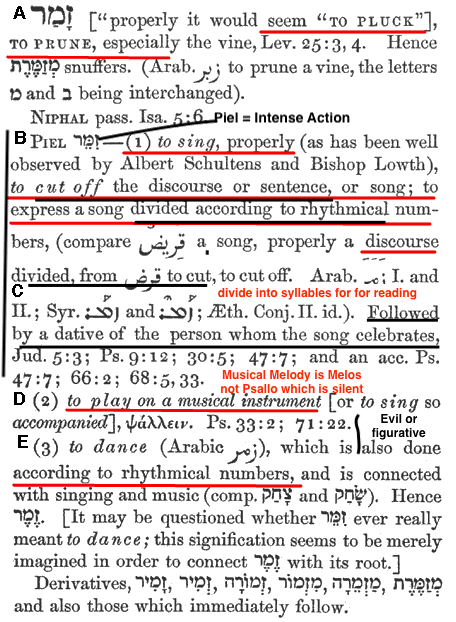
h2167.Zamar.branch.gif
God is not so carnal that He supplied not a single example of people said to WORSHIP by speaking, listening, singing, playing, acting or PAY TO PLAY

No godly Jew ever assembled even at the temple to WORSHIP by doing anything more than falling on their face in reverence and godly fear


John T. Willis:
This makes it quite clear that in Israelite WORSHIP
        both singing and playing on instruments of music were WORSHIP activities.
It would be unthinkable here to contend that singing was WORSHIP,
        and playing on instruments was an aid to WORSHIP
.
Dan. 3:7 Therefore at that time, when all the people heard the sound of the cornet, flute, harp, sackbut, psaltery, and all kinds of musick, all the people, the nations, and the languages, fell down and worshipped the golden image that Nebuchadnezzar the king had set up.
Amos 5:24 BUT let judgment run down as waters, and righteousness as a mighty stream.
Amos 5:25 Have ye offered unto me sacrifices and offerings in the wilderness forty years, O house of Israel?

Amos 5:26 But ye have borne the tabernacle of your Moloch and Chiun your images,

        the STAR of your god, which ye made to yourselves.

Molech . . . Chiun--"Molech" means "king" answering to Mars [BENGEL]; the Sun [JABLONSKI]; Saturn, the same as "Chiun" [MAURER]. The Septuagint translates "Chiun" into Remphan, as Stephen quotes it (Ac 7:42,43). The same god often had different names.

Molech is the Ammonite name; Chiun, the Arabic and Persian name, written also Chevan. In an Arabic lexicon Chiun means "austere"; so astrologers represented Saturn (666) as a planet baleful in his influence. Hence the Phoenicians offered human sacrifices to him, children especially; so idolatrous Israel also. Rimmon was the Syrian name (2Ki 5:18); pronounced as Remvan, or "Remphan," just as Chiun was also Chevan. Molech had the form of a king; Chevan, or Chiun, of a star [GROTIUS]. Remphan was the Egyptian name for Saturn: hence the Septuagint translator of Amos gave the Egyptian name for the Hebrew, being an Egyptian. [HODIUS II, De Bibliorum Textibus Originalibus. 4.115]. The same as the Nile, of which the Egyptians made the star Saturn the representative [HARENBERG]. BENGEL considers Remphan or Rephan akin to Teraphim and Remphis, the name of a king of Egypt. Jamieson Fausset Brown Bible Commentary

The Hebrews became infected with Sabeanism, the oldest form of idolatry, the worship of the Saba or starry hosts, in their stay in the Arabian desert, where Job notices its prevalence (Job 31:26); in opposition, in Am 5:27, Jehovah declares Himself "the God of hosts." the star of your god--R. ISAAC CARO says all the astrologers represented Saturn as the star of Israel. Probably there was a figure of a star on the head of the image of the idol, to represent the planet Saturn; hence "images" correspond to "star" in the parallel clause. A star in hieroglyphics represents God (Nu 24:17). "Images" are either a Hebraism for "image," or refer to the many images made to represent Chiun.
AMOS AND PAUL REFERENCE THE MOUNT SINAI INSTRUMENTAL-TRINITARIAN-PERVERTED "PLAY" AT MOUNT SINAI.

Romans.1.html
   This appears in literature as the CAUSE AND EFFECT now drowing society.

Rom. 1:23 And changed the glory of the uncorruptible God
        into an image made like to corruptible man, and to birds,
        and fourfooted beasts, and creeping things.
Rom. 1:24 Wherefore God also GAVE THEM UP to UNCLEANESS t
        hrough the lusts of their own hearts,
         to dishonour their own bodies between themselves:
Rom. 1:25 Who changed the truth of God into a lie,
        and worshipped and served the creature more than the Creator, who is blessed for ever. Amen.
Rom. 1:26 For this cause God gave them up unto vile affections:
        for even their women did change the natural use into that which is against nature:
Rom. 1:27 And likewise also the men,
        leaving the natural use of the woman,
        burned in their lust one toward another;
        men with men working that which is unseemly,
        and receiving in themselves that recompence of their error which was meet.
Rom. 1:28 And even as they did not like to retain God in their knowledge,
        God gave them over to a reprobate mind, to do those things which are not convenient;

John T. Willis says that this is the PATTERN commanded for the church.

Amos 5:1  Hear ye this word which I take up against you, even a lamentation, O house of Israel.
Amos 5:2 The virgin of Israel is fallen; she shall no more rise: she is forsaken upon her land; there is none to raise her up.

Amos 5:21  I hate, I despise your feast days, and I will not smell in your solemn assemblies.
Amos 5:22 Though ye offer me burnt offerings and your meat offerings, I will not accept them: neither will I regard the peace offerings of your fat beasts.
Amos 5:23 Take thou away from me the noise of thy songs; for I will not hear the melody of thy viols.
Amos 5:24 BUT let judgment run down as waters, and righteousness as a mighty stream.

In the context in which God proclaimed this oracle through Amos,
        he is not condemning the use of harps (or other musical instruments)
        per se in worship any more
                than he is condemning regular attendance at feasts
                and solemn assemblies,
                animal and cereal sacrifices, or singing.
Rather, he is reproving the faithful execution of these things
        by
the very people who treat the helpless poor unjustly and unrighteously
        (cf. similar oracles in 4:4-5; Hosea 6:4-6; Isaiah 1:10-17; 29:13-14; 58:1-8; Micah 6:6-8; Jeremiah 7:1-4, 21-23; Joel 2:12-13).

Amos 5:25 Have ye offered unto me sacrifices and offerings in the wilderness forty years, O house of Israel?
Amos 5:26 But ye have borne the tabernacle of your Moloch and Chiun your images,
        the STAR of your god, which ye made to yourselves.
Acts 7:41 And they made a calf in those days,
        and offered sacrifice unto the idol,
        and REJOICED in the works of their OWN HANDS
Brandon Scott Thomas ZOE is Venus or LUCIFER.


Brandon.Scott.Thomas.Molech.Col.Wiki.gif

The ROCK upon which anything beyond learning is built:

Pind. I. 1 May rocky Delos, in whose praises I have poured myself out, not be indignant at me.
[5] What is dearer to good men than their noble parents? Yield, island of APOLLO; indeed, with the help of the gods I shall accomplish the end of both graceful songs, honoring in the dance both Phoebus with the unshorn hair
The Goddess as Lady of Beasts was known to the people of Sumer, Crete, and the Indus Valley (India). Her name is largely unknown because worship of her predated writing. She was also known as the Cosmic Creatrix, the creative, fertile, life-giving force. Her special animals were held sacred as manifestations of the deity herself. She is depicted here pregnant, surrounded by pregnant animals, which speaks of her as a powerful fertility figure. She usually appears enthroned with a lion at her side.

Initially a Hunter Goddess and Lady of the Beasts of Kolchis named Aeaea 'ululation,' she became the funerary Goddess of the island known by her name. Kalypso 'concealer,' Argeia 'bright,' and often Medea 'wise one' who was sometimes called her neice instead. Klymene's daughters were the keepers of golden horned cattle in the lands of the Dead, the Heliades or Merope 'eloquent' or 'bee eater,' Helia 'sun,' Phoebe 'bright,' Aetheria 'heavenly one,' Dioxippe 'divine mare,' Lampetia 'beaming one,' Koronis 'crow or raven,' Aegile 'bright,' Lamethusa 'light being,' Phatusa 'bright being,' and Elektryone 'beaming on

"The marzeah had an extremely long history extending at least from the 14th century B.C. through the Roman period. In the 14th century B.C., it was prominently associated with the ancient Canaanite city of Ugarit (modern Ras Shamra), on the coast of Syria... The marzeah was a pagan ritual that took the form of a social and religious association... Some scholars regard the funerary marzeah as a feast for--and with--deceased ancestors (or Rephaim, a proper name in the Bible for the inhabitants of Sheol)." (King, Biblical Archaeological Review, Aug, 1988, p. 35, 35) ---- "These five elements are: (1) reclining or relaxing, (2) eating a meat meal, (3) singing with harp or other musical accompaniment, (4) drinking wine and (5) anointing oneself with oil." (King, p. 37).

"In pagan traditions, musical instruments are invented by gods or demi-gods, such as titans. In the Bible, credit is assigned to antediluvian patriarchs, for example, the descendants of Cain in Genesis 4:21. There is no other biblical tradition about the invention of musical instruments." (Freedman, David Noel, Bible Review, Summer 1985, p. 51).

FEMINISTS HAVE NOW RULED OVER YOU ACCOMPANIED BY "BOYS" CAUGHT IN THE GENDER TRAP.  THIS IS GNOSTICISM AND THOSE WHO DEMAND  TO BE HEARD AS THE "DAUGHTERS OF EVE.

http://www.pineycom.com/ApocJesDance.html

Jeanene.P.Reese.Theology.of.Women.Teachers
"Men must serve women because the Earth was the Mother."
Which proccuces: Jeanene.Reese.LGBT.MUST.be.Included

THE BACKGROUND to ancient and new Gnosticism:

The rulers took counsel with one another and said, "Come, let us cause a deep sleep to fall upon Adam." And he slept. - Now the deep sleep that they "caused to fall upon him, and he slept" is Ignorance. - They opened his side like a living woman. And they built up his side with some flesh in place of her, and Adam came to be endowed only with soul.

And the spirit-endowed woman came to him and spoke with him, saying, "Arise, Adam."

And when he saw her, he said, "It is you who have given me life (Zoe); you will be called 'mother of the living'. -

For it is she who is my mother. It is she who is the physician, and the woman, and she who has given birth."

Then the female spiritual principle came in the snake, the instructor; and it taught them, saying, "What did he say to you? Was it, 'From every tree in the garden shall you eat; yet - from the tree of recognizing good and evil do not eat'?"

The carnal woman said, "Not only did he say 'Do not eat', but even 'Do not touch it; for the day you eat from it, with death you are going to die.'" And the snake, the instructor, said, "With death you shall not die; for it was out of jealousy that he said this to you. Rather your eyes shall open and you shall come to be like gods, recognizing evil and good." And the female instructing principle was taken away from the snake, and she left it behind, merely a thing of the earth.

And the carnal woman took from the tree and ate; and she gave to her husband as well as herself; and these beings that possessed only a soul, ate. And their imperfection became apparent in their lack of knowledge; and they recognized that they were naked of the spiritual element, and took fig leaves and bound them upon their loins.

Clement of Alexandria notes:

And what if I go over the mysteries? I will not divulge them in mockery, as they say Alcibiades did, but I will expose right well by the word of truth the sorcery hidden in them; [The singers, musicians, theater builders and sage managers and grinders in Revelation 18:22 performed the work of SORCERY to deceive the nations. As a result, the put out the candles of seven spirits."

and those so-called gods of yours, whose are the mystic rites, I shall display, as it were, on the stage of life, to the spectators of truth.

The bacchanals hold their orgies in honour of the frenzied Dionysus, celebrating their sacred frenzy by the eating of raw flesh, and go through the distribution of the parts of butchered victims, crowned with snakes, shrieking out the name of that Eva by whom error came into the world. The symbol of the Bacchic orgies. is a consecrated serpent. Moreover, according to the strict interpretation of the Hebrew term, the name Hevia, aspirated, signifies a female serpen

ACU-OSBURN.html  the ACU Agenda

Trainers use PROPHETIC roles to Channel and Facilitate the method of
        SUBVERTING the 'hierarchial " views of JESUS and PAUL.
       "
Feminist HERMENEUTICS stands over AGAINST patriarchal HERMENEUTICS"
        its
goal achieved "by small, often unnoticed acts of SUBVERSION.
        Numerous such
incremental changes, like EROSION,
        will eventually bring DOWN the FORTRESS
"

Exodus.32.Worship.of.Golden.Calf

Exod 32:6 And they rose up early on the morrow,  and offered burnt offerings, and brought peace offerings; 
        and the people sat down to eat and to drink, and rose up to play


Moloch.harp.drum.flute.gifh6711.tsachaq.gif
euphrainō  II. Pass., make merry, enjoy oneself, “euphrainesthai hekēlon” 

Pind. I. 1 My mother, Thebe of the golden shield, I shall place your interests above my lack of leisure. 
   
agōnio   without angle  2. agōniō skhola” (Corner silent for LEARNING only)
    askhol-ia  OPPOSITE  hēsukhia, required to LEAR IN SILENCE: a female probllem

euphrainō 
Pl.Lg.796b ,Nor should we omit such mimic dances as are fitting for use by our choirs,—for instance, the sword-dance of the Curetes here in Crete, and that of the Dioscori in Lacedaemon; and at Athens, too, our Virgin-Lady gladdened by the pastime of the dance deemed it not seemly to SPORT with empty hands

SPORT. Rise up to PLAY paizō
5. play amorously, “pros allēlousX.Smp.9.2
4. play on a musical instrument, h.Ap.206: c. acc., “Pan ho kalamophthogga paizōnAr.Ra.230; dance and sing, Pi. O.1.16.
      Xen. Sym. 9.2  After he had withdrawn, a chair of state, first of all, was set down in the room, and then the Syracusan came in with the announcement: “Gentlemen, Ariadne will now enter the chamber set apart for her and Dionysus; after that, Dionysus, a little flushed with wine drunk at a banquet of the gods, will come to join her; and then they will disport themselves together.”


Amos 5:27 Therefore will I cause you to go into captivity
         beyond Damascus, saith the LORD, whose name is The God of hosts.
Acts 7:42 Then God turned, and gave them up to worship the host of heaven;
        as it is written in the book of the prophets, O ye house of Israel,
        have ye offered to me slain beasts and sacrifices by the space of forty years in the wilderness?
Acts 7:43 Yea, ye took up the tabernacle of Moloch, 
        and the star of your god Remphan, 
        figures which ye made to worship them: 
        and I will carry you away beyond Babylon.

Therefore will I cause you to go into captivity beyond Damascus, saith the Lord, whose name is The God of hosts. Amos 5:27

27. beyond Damascus--In Ac 7:43 it is "beyond Babylon," which includes beyond Damascus. In Amos time, Damascus was the object of Israel's fear because of the Syrian wars. Babylon was not yet named as the place of their captivity. Stephen supplies this name. Their place of exile was in fact, as he states, "beyond Babylon," in Halah and Habor by the river Gozan, and in the cities of the Medes (2Ki 17:6; compare here Am 1:5 4:3 6:14). The road to Assyria lay through "Damascus." It is therefore specified, that not merely shall they be carried captives to Damascus, as they had been by Syrian kings (2Ki 10:32,33 13:7), but, beyond that, to a region whence a return was not so possible as from Damascus

ŏpŭlentus  B. [select] Of respectability or rank, respectable, powerful, noble: opulenti pariter atque ignobiles,

ludos opulentius instructiusque facere,Liv. 1, 35, 7

lūdus A. In gen., a play, game, diversion, pastime, , spectacles, shows, exhibitions, which were given in honor of the gods, “hoc praetore ludos Apollini faciente,Cic. Brut. 20, 78
 
2. Stage-plays Dionysius Corinthi dicitur ludum aperuisse,făcĭo
....făcĭo  anything YOU make or do;
poëma,to compose, id. Pis. 29, 70: “carmina,Juv. 7, 28: “versus,id. 7, 38: “sermonem,Cic. Fam. 9, 8, 1; cf. “litteram,id. Ac. 2, 2, 6: ludos, to celebrate, exhibit audientiam orationi

Isa 57:4 Against whom do ye sport yourselves? against whom make ye a wide mouth, and draw out the tongue? are ye not children of transgression, a seed of falsehood,

Lūdo , ” Verg. E. 6, 1.—Esp., to play on an instrument of music, to make or compose music or song: “ludere quae vellem calamo permisit agresti,Verg. E. 1, 10:  Delude or Deceive.quod tenerae cantent, lusit tua musa, puellae,id. Am. 3, 1, 27: “coloni Versibus incomptis ludunt,Verg. G. 2, 386: “carmina pastorum,

in -strŭo , 1. To set in order, draw up in battle array: to lay an ambush, A. In gen., to procure, provide for, prepare for, furnish: in instruendo (orationem) dissipatus,

CHIEF  pompātĭcus , a, um, adj. pompa, I.showy, pompous, splendid (post-class.): “femina, Tert. Cult. Fem. 9: “genus vehiculi, for state occasions,Isid. 20, 12, 3.—Hence, adv.: pompātĭcē , with display, pompously, Vulg. Amos, 6, 1;Jul. Vict. Rhet. 10, p. 233: favor,

Amos 6.[7] quapropter nunc migrabunt in capite transmigrantium et mauferetur factio lascivientium

migrabun to remove from one place to another, to depart, flit, migrate

lascīvĭo , ĭi, ītum, 4, v. n. lascivus,
I. [select] to be wanton, petulant, sportive, to sport, frisk, frolic
to indulge in license of language or style

Mirzach (h4797) meer-zakh'; from an unused root mean. to scream; a cry, i. e. (of joy), a revel: - banquet.

Marzeach (h4798) mar-zay'-akh; formed like 4797; a cry, i. e. (of grief) a lamentation: - mourning.

For thus saith the Lord, Enter not into the house of mourning, neither go to lament nor bemoan them: for I have taken away my peace from this people, saith the Lord, even lovingkindness and mercies. Je.16:5

STRONGS H4797:
מַרְזֵחַ noun masculineAmos 6:7 cry ( מַרְזְחָא mourning- feast; Phoenician מרזח a rel. festival (> usually a month), compare Palmyrene, ClGann Littm, see GACookeInscr. 95. 121 f. 303 and references; LzbEphem. i. 47 f. 343 f.); **LzbEphem. ii. 231 ברבנות מרזחותה די כמרי בל. —
1. mourning cry (or feast? Talmud מִרְזֵיחָא), absolute בֵּית מ׳ [H4798 Jeremiah 16:5] i.e. house of mourning (|| ספד, נוד).
2. cry of revelry, construct מִרְזַח סְרוּחִים Amos 6:7.

Conrad L'Heureux demonstrated that the marzeah, or symposium (feast, gathering, banquet, assembly) of El that is found in the Rephaim Texts of Ugarit "must be a reflex in the divine world of the symposium celebrated by the members of the earthly marzeah of El...each guild apparently had a divine patron."42 The heavenly marzeah had participants called rp'm, which we also find in the earthly marzeah, e.g., "May Krt be greatly exalted among the rp'm of the earth...the rp'm constitute an aristocracy of which the Canaanite kings were a part."43 Moses, and the prophets following him were proclaimed as "Speakers for Yahweh," showing the people that "they are sent from the divine king, the suzerain of treaties, to reprove and to pronounce judgment upon Israel..."44

Note 42: Conrad L'Heureux, "The Ugaritic and Biblical Rephaim," Harvard Theological Review, 67(1974): 270-271.

Note 43. Conrad L'Heureux, Rephaim, 271. Cf. 272, footnote 25, the authority of El is ordinarily exercised through the younger generation of gods whom we could call the executive deities. It is also possible to understand the term rp'm as "the assembly of the gods." The entire premise of Jacobsen's article "Primitive Democracy," is that the groups and assemblies on earth reflected what the gods had done in heaven.
"With the wine-drinking (which is the literal meaning of the Hebrew for feasting), went music and dancing." (Heaton, E. W., Everyday Life in Old Testament times, Scribners, p. 93)

"Worship was form more than substance; consequently, conduct in the marketplace was totally unaffected by worship in the holy place. Amos spoke from the conviction that social justice is an integral part of the Mosaic covenant, which regulates relations not only between God and people, but also among people." (King, p. 44). 

"In pagan traditions, musical instruments are invented by gods or demi-gods, such as titans. In the Bible, credit is assigned to antediluvian patriarchs, for example, the descendants of Cain in Genesis 4:21. There is no other biblical tradition about the invention of musical instruments." (Freedman, David Noel, Bible Review, Summer 1985, p. 51).

The Marzeah in Amos 5

"The marzeah had an extremely long history extending at least from the 14th century B.C. through the Roman period. In the 14th century B.C., it was prominently associated with the ancient Canaanite city of Ugarit (modern Ras Shamra), on the coast of Syria...

The marzeah was a pagan ritual that took the form of a social and religious association... Some scholars regard the funerary marzeah as a feast for--and with--deceased ancestors (or Rephaim, a proper name in the Bible for the inhabitants of Sheol)." (King, Biblical Archaeological Review, Aug, 1988, p. 35, 35)

"These five elements are:
........(1) reclining or relaxing,
........(2) eating a meat meal,
........(3) singing with harp or other musical accompaniment,
........(4) drinking wine and
........(5) anointing oneself with oil." (King, p. 37).

THIS WAS RISING UP TO PLAY AND THE PLAY OF DAVID WHERE EVERYONE GOT A SHARE OF FOD.

"we recognize the same elements: the sacrifices and libation, the cultic feast in which the congregation gets a share of food and drink after it has been blessed by the king, and the merry-making, now in the form of instrumental and vocal music. But the central act of the ritual, which was performed by the king, is called literally 'drinking' the god (Gurney, O. R. Some Aspects of Hittite Religion, p. 33-34, Oxford University Press, 1977)

This won't shock the literate who know that because of the MUSICAL IDOLATRY at Mount Sinai God TURNED THEM OVER to worship the starry host.

"The normal order of events was a meal, followed by a drinking party. Entertainment might include anything from a rhetorcian or philosopher discoursing on some topic, to musical entertainment, to sexual dalliance."

"Plutarch implicitly contrasts a serious dinner featuring a sage as the after-dinner speaker with the other sorts of dinners--where sexual play with the girl flute-players or hetairae was common." (Witherington, Ben, Why Not Idol Meat, Bible Review, June 1994, p. 41-42

Amos 6:4 That lie upon beds of ivory, and stretch themselves upon their couches, and eat the lambs out of the flock, and the calves out of the midst of the stall;

Amos 6:5 That chant to the sound of the viol, and invent to themselves instruments of musick, like David;

Amos 6:6 That drink wine in bowls, and anoint themselves with the chief ointments: but they are not grieved for the affliction of Joseph.

Amos 6.[7] quapropter nunc migrabunt in capite transmigrantium et mauferetur factio lascivientium

migrabun to remove from one place to another, to depart, flit, migrate

lascīvĭo , ĭi, ītum, 4, v. n. lascivus,
I. to be wanton, petulant, sportive, to sport, frisk, frolic
to indulge in license of language or style
in Venerem,to be lascivious, Col. 6, 24, 2.— Venus or Lucifer


lascivimus syntonorum modis saltitantes,
2. The measure of tones, measure, rhythm, melody, harmony, time; in poetry, measure, metre, mode: “vocum,Cic. Div. 2, 3, 9: “musici,Quint. 1, 10, 14: “lyrici
AND DANCING
mŏdus ,

Mirzach (h4797) meer-zakh'; from an unused root mean. to scream; a cry, i. e. (of joy), a revel: - banquet.

Marzeach (h4798) mar-zay'-akh; formed like 4797; a cry, i. e. (of grief) a lamentation: - mourning.

For thus saith the Lord, Enter not into the house of mourning, neither go to lament nor bemoan them: for I have taken away my peace from this people, saith the Lord, even lovingkindness and mercies. Je.16:5

STRONGS H4797:
מַרְזֵחַ noun masculineAmos 6:7 cry ( מַרְזְחָא mourning- feast; Phoenician מרזח a rel. festival (> usually a month), compare Palmyrene, ClGann Littm, see GACookeInscr. 95. 121 f. 303 and references; LzbEphem. i. 47 f. 343 f.); **LzbEphem. ii. 231 ברבנות מרזחותה די כמרי בל. —
1. mourning cry (or feast? Talmud מִרְזֵיחָא), absolute בֵּית מ׳ [H4798 Jeremiah 16:5] i.e. house of mourning (|| ספד, נוד).
2. cry of revelry, construct מִרְזַח סְרוּחִים Amos 6:7.


Amos 6:8 The Lord GOD hath sworn by himself, saith the LORD the God of hosts, I abhor the excellency of Jacob, and hate his palaces: therefore will I deliver up the city with all that is therein.
Amos 6:9 And it shall come to pass, if there remain ten men in one house, that they shall die.
Amos 6:10 And a man’s uncle shall take him up, and he that burneth him, to bring out the bones out of the house, and shall say unto him that is by the sides of the house, Is there yet any with thee? and he shall say, No. Then shall he say, Hold thy tongue: for we may not make mention of the name of the LORD.
Amos 6:11 For, behold, the LORD commandeth, and he will smite the great house with breaches, and the little house with clefts.
Amos 6:12 Shall horses run upon the rock? will one plow there with oxen?
        for ye have turned judgment into gall, and the fruit of righteousness into hemlock:
Amos 6:13 Ye which REJOICE in a thing of nought, which say,
        Have we not taken to us horns by our own strength?
Amos 6:14 But, behold, I will raise up against you a nation, O house of Israel, saith the LORD the God of hosts; and they shall afflict you from the entering in of Hemath unto the river of the wilderness.

web counter

<a href="https://www.hitwebcounter.com" target="_blank">
<img src="https://hitwebcounter.com/counter/counter.php?page=7890695&style=0032&nbdigits=5&type=ip&initCount=0" title="Free Counter" Alt="web counter"   border="0" /></a>